
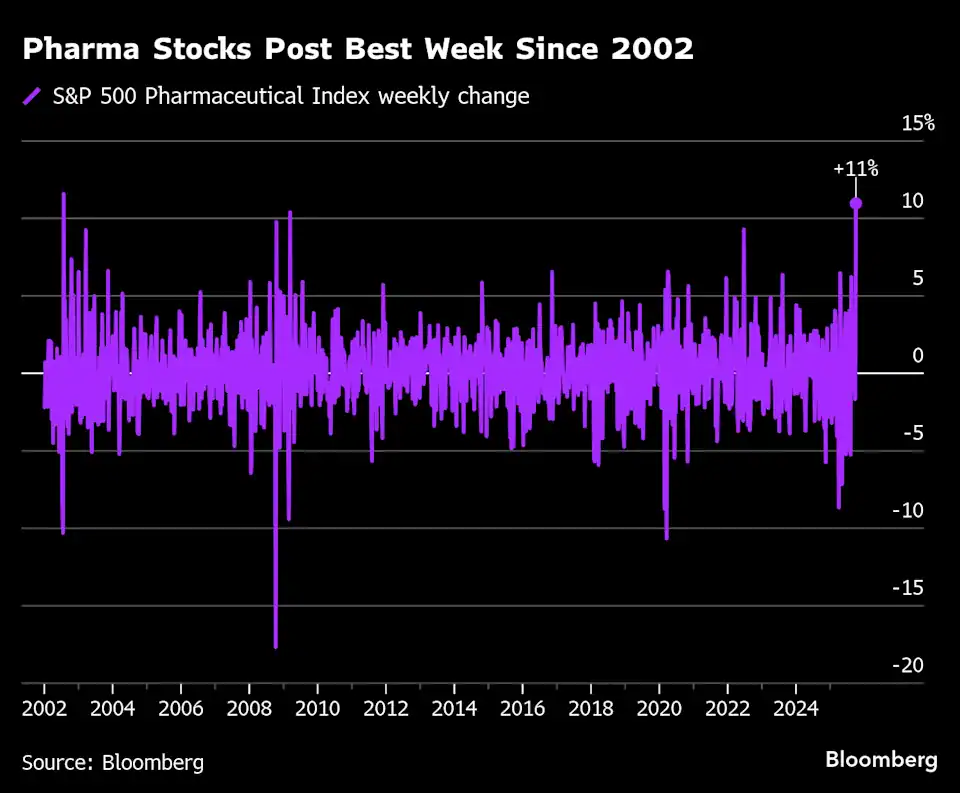
(Bloomberg) — Pharmaceutical stocks capped off their best week in 23 years as a drug-pricing and tariff deal with the US government helped ease an overhang that’s been weighing on the sector for most of the year.
The group’s advance was spurred by Pfizer Inc. on Tuesday when it agreed to slash some of its drug prices for Americans enrolled in the Medicaid insurance program in exchange for a three-year reprieve on import tariffs. The New York-based company also agreed to invest $70 billion in the US as part of an agreement with President Donald Trump.
The deal was seen as another sign of easing pressures on the pharmaceutical industry since the president announced possible future tariffs on drug imports in April as well as drug-pricing reforms in May. It followed Trump’s move last week to exempt companies with US manufacturing from pharmaceutical levies in the first signal of relief for the sector.
The S&P 500 Pharmaceuticals Index rallied 11% over the past five sessions, in its best weekly gain since July 2002 when drugmakers surged amid a flurry of positive news including FDA approvals and better-than-expected quarterly reports. Prior to Tuesday, the group had been down about 3.4% for the year.
All in all, Tuesday’s deal was “the second major ‘could have been a lot worse’ moment for the industry in recent days,” according to Adam Crisafulli of Vital Knowledge. “If the Pfizer deal from Tuesday serves as the template for other large pharma and biotech companies, the worst-case scenario will have been avoided,” he added.
That’s because Pfizer’s exposure to Medicaid is low and its agreement with President Trump to provide a most-favored-nation pricing for the government program, is expected to have limited financial impact for the company in the near term.
“Not only is Pharma’s EPS exposure to Medicaid low compared to other channels, we estimate Pfizer is at the low end of the Pharma industry with ~2% of 2025 EPS coming from Medicaid,” TD Cowen analyst Steve Scala wrote in a note to clients.
While the deal is specific to Pfizer alone, many on Wall Street are betting that other drugmakers would follow Pfizer’s lead and make similar deals. That will in turn soften any blows to the pharmaceutical industry’s profits from the aggressive drug-pricing or tariff policies that the administration might impose.
Eli Lilly & Co. and Merck could be next in line to announce similar agreements, according to BMO Capital Markets analyst Evan David Seigerman.
“While the broader Pharma market is appreciating meaningfully as a result of this deal, other Pharma players will need to make their own deals with the administration to secure the same fate as Pfizer,” Seigerman said.
Pfizer shares posted their biggest weekly gain in data going back to at least 1980 while Merck’s stock jumped roughly 14% for its best week since March 2009. Lilly shares also gained 16% in their biggest weekly advance since April. All three names were in the red year-to-date prior to Tuesday’s deal, compared to the S&P 500 Index’s gain of about 13% for the same period.
For Lilly, the president said in May that the Indianapolis, Indiana-based company will not be subjected to tariffs because it is building manufacturing facilities in the US. The drugmaker has said it’s in active discussions with the administration to further expand patient access.
Other sectors are also benefiting from Pfizer’s deal. Life sciences companies that are involved with drug manufacturing also saw their shares climb this week, with the S&P Composite 1500 Life Sciences and Tools Index (S15LSTS) jumping by a record 15% over the past five sessions.
Tool-makers, which get most of their revenue selling lab equipment and supplies that drug developers use to research, discover and produce new treatments, typically get hit hard by a slump in the health-care sector. Pharmaceutical firms have had to reduce R&D priorities as they try to mitigate the potential impact of looming tariffs and drug-pricing policies that threatened to erode profitability.
Pfizer’s deal “potentially provides an off-ramp to the pressures seen by LST companies and potential for upside if the onshoring of manufacturing plants and facilities were to materialize,” Leerink Partners analyst Puneet Souda wrote in a note to clients.