
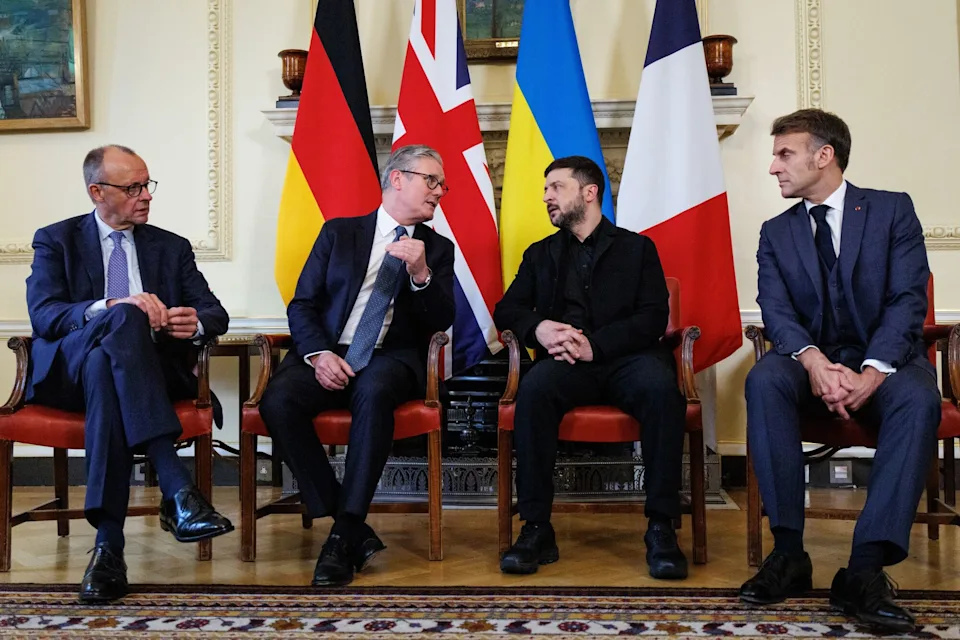
(Bloomberg) — European leaders are increasingly confident they will reach a deal to use frozen Russian assets before the end of the year following talks in London, even as a gulf remains between Europe and the US on providing security guarantees for Kyiv.
Volodymyr Zelenskiy and his allies made “positive progress” on using immobilized Russian sovereign assets to back a €90 billion ($105 billion) loan for Ukraine’s reconstruction, UK Prime Minister Keir Starmer’s office said following the meeting on Monday. European leaders are optimistic an agreement can be reached before Christmas, and perhaps even as soon as this week, people familiar with the matter said, asking not to be named discussing private assessments.
Ukraine’s allies are under growing pressure to find fresh sources of financing after US President Donald Trump’s administration largely stopped aid to the war-ravaged country. As peace talks between Washington, Moscow and Kyiv intensified in recent weeks, the US has even suggested that it could use the money for post-war investments.
The European Union last week put forward a proposal to use the immobilized assets as it estimates Ukraine will need €135 billion over the next two years to keep basic services running and to prop up its military.
But the EU has had to contend with opposition to the plan from within the bloc from several countries including Belgium, where most of the funds are held. The leaders will meet in Brussels on Dec. 18 to seek agreement.
“We are now quite close to finding a legally and politically sustainable solution,” Finnish Foreign Minister Elina Valtonen told Bloomberg TV in an interview on Monday. “I think using the Russian central bank’s assets for funding the survival of Ukraine is not only morally, but in so many other ways, also the right thing to do.”
The London meeting between Starmer, Zelenskiy and leaders of France and Germany took place against a backdrop of concern in European governments that a US-brokered peace initiative to end the conflict in Ukraine risked making too many concessions to Russian leader Vladimir Putin.
The leaders “aligned a shared position on the importance of security guarantees and reconstruction, and agreed on the next steps,” Zelenskiy said on X. His remarks suggest the meeting failed to deliver a breakthrough on what is a key component of any peace settlement with Russia that Kyiv can accept.
Control over eastern regions of Ukraine as well as security guarantees from allies are among a number of “sensitive issues” that require further discussions, Zelenskiy told Bloomberg News earlier on Monday.
The London meeting was followed by a call with leaders from the EU, Finland, Norway, Italy, Denmark, Poland, Sweden, the Netherlands, NATO and a senior representative from Turkey. The British statement noted that national security advisers for European governments would continue discussions in coming days.
“The leaders all agreed that now is a critical moment and that we must continue to ramp up support to Ukraine and economic pressure on Putin to bring an end to this barbaric war,” Starmer’s office said.
In the course of several frenetic weeks of negotiations, Ukraine has managed to water down an initial 28-point peace plan floated by the US, which appeared favorable to Russia by attempting to bar Kyiv from joining NATO and capping the size of its army. A new 20-point framework document has emerged, but there remains little clarity on how Moscow will be deterred from launching another attack in the future.
Trump said on Sunday he was “a little bit disappointed” in Zelenskiy, who he claimed hadn’t yet read the proposal. Moscow, on the other hand, was “fine with it,” Trump told reporters. Ukraine has been under growing US pressure to agree to a deal.
Zelenskiy said he may send the latest draft version of the peace plan to Washington on Tuesday. Ukraine is looking for legally binding security guarantees from the US that are approved by Congress, the president told reporters during his flight to Brussels late on Monday.
Trump has grown increasingly impatient with the lack of progress in talks to end the war, which he had pledged to resolve within 24 hours of taking office. In doing so, he’s repeatedly sounded sympathetic to Russia, the country that started the full-scale invasion of its smaller neighbor almost four years ago. Last week, a US national security strategy document signed by Trump said European governments “hold unrealistic expectations for the war.”
Ukraine’s European allies have largely been shut out of the American-led diplomacy, prompting a series of senior European officials to visit Washington in the coming weeks to urge for unity on Ukraine. UK Foreign Secretary Yvette Cooper, following a meeting with Secretary of State Marco Rubio, will give a speech to European diplomats in London on Tuesday calling on them to revive international collaboration to tackle the hybrid threats facing Western allies.
Trump has dispatched his special envoy, Steve Witkoff, and son-in-law Jared Kushner to work over the proposal in talks in Moscow, while Ukrainian officials have shuttled between Kyiv, Geneva and Florida.
Arriving in London for the talks with Starmer, Zelenskiy said his country needed unity among its main allies to secure a pact. But he also signaled that the talks with the US have yet to yield agreement on Ukraine’s Donbas, including the provinces of Donetsk and Luhansk.
The US said on Friday that negotiators had locked in an agreement with Kyiv on a “framework of security arrangements” and discussed what was needed to prevent another attack, though there was little indication of a major breakthrough.
“There are visions of the US, Russia and Ukraine — and we don’t have a unified view on Donbas,” Zelenskiy told Bloomberg News earlier Monday.
The Kremlin is demanding that Ukraine cede areas of the Donetsk region that its troops failed to take by force in almost four years of war. The US has proposed making the area a de-militarized zone. Zelenskiy and European allies have repeatedly said a ceasefire must be imposed along the current front line, rejecting a demand for the Ukrainian army to withdraw.
After the meeting in London, Zelenskiy headed on to Brussels for further talks with European officials, and plans to then fly to Rome for a meeting with Italian Prime Minister Giorgia Meloni on Tuesday.
“After that, we will have our joint vision” for the talks, Zelenskiy said. “And I am ready to fly to the US if the president is ready for such a meeting.”