
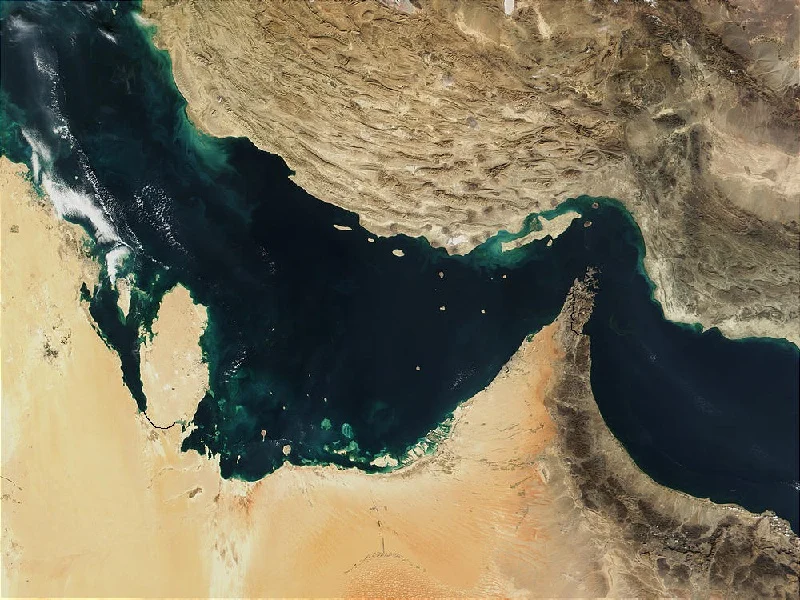
US President Donald Trump is desperate to reopen the Strait of Hormuz to ease a growing global energy crisis. He won’t achieve that easily without a ceasefire in the war on Iran.
Iran’s sporadic attacks on vessels and the threat of mines have cut traffic in the vital waterway to a trickle, effectively putting Tehran, not outside naval forces, in charge of the flow. The strait carries about a fifth of the world’s oil supplies, and the disruption has led to production cuts, fuel shortages and price increases from Asia to Europe and Africa.
Trump has been pressing allies to send warships to help reopen the strait, proposing a multinational naval effort to escort commercial ships.
European and Asian partners are reluctant, with governments from Berlin to Tokyo questioning whether a handful of ships would make any difference against Iran’s ability to threaten vessels. Officials say additional navies would add little beyond the substantial US presence already in the region — and still fall far short of what’s needed to meaningfully unblock the strait.
“It could take several weeks to secure the Strait of Hormuz,” said Bob McNally, president of Rapidan Energy Group and a former White House official. “Until we’ve neutralized Iran’s layered, asymmetric capabilities — mines, fast attack craft, submarines and drones — we won’t want to put commercial or even escort ships through.”
Trump responded to the lack of enthusiasm from potential partners on Tuesday, saying the US no longer needs assistance, either from NATO countries or Japan, Australia and South Korea. He didn’t specifically mention Hormuz.
With the war ongoing, the only transit happening appears to be on Iran’s terms. A handful of vessels have made their way out by hugging the Iranian coast, suggesting passage depends on Tehran’s approval rather than outside protection. The result is a system where the strait isn’t formally closed, but access is controlled — and normal commercial flows remain far out of reach.
Those skeptical of the US escort idea point to the recent history in the Red Sea on the other side of the Arabian Peninsula. There, Houthi militias in Yemen used similar tactics to disrupt traffic through the Bab al-Mandeb strait, despite bombing campaigns from the US and others.
UK Prime Minister Keir Starmer said Monday that his country won’t be dragged into the war and that opening the Strait of Hormuz is “not straightforward.”
“You can see that historically when there have been other conflicts that have affected the straits,” he said.
On Tuesday, French President Emmanuel Macron said France won’t take part in operations yet. But he’s ready to work with others on a system of escorts when the situation is calmer.
“We are not a party to the conflict and therefore France will never take part in operations to open or free the Strait of Hormuz in the current context,” Macron said. “Once the situation has calmed down — that is, once the core of the bombardments has ceased — we are ready, together with other nations, to take responsibility for an escort system.”
Military analysts largely agree that, absent a truce, escorts are risky.
“The military solution is the least good solution,” said Tom Sharpe, a former UK naval officer who was previously deployed to the Persian Gulf. “It’s more of a political issue.”
“What Iran is doing now is what we’ve seen the Houthis did in the Red Sea,” he added. “Just a few projectiles and it’s enough to scare ships away.”
The war is now in its third week, with no sign of easing. Since the first US-Israel attacks on Iran began on Feb. 28, Brent crude oil has surged about 40% to more than $100 a barrel. US gasoline pump prices have climbed, while diesel and jet-fuel supplies have tightened amid attacks on energy infrastructure and the Hormuz disruption.


Even if the US pulls together a coalition of countries to provide escorts, any impact would be limited. It would be far from a return to normal traffic.
The strait is narrow — barely 30 miles (48 kilometers) wide at its tightest point — putting shipping lanes within easy reach of missiles, drones and small boats. Insurers and banks are likely to remain wary of routes close to Iran, where sanctions exposure and the risk of attack make voyages difficult to underwrite or finance.
Trump acknowledged the problem at the weekend. Even though Iran’s military is “already destroyed 100%,” it would be “easy” for Tehran to continue threatening ships with drones, mines and short-range missiles, he said.
Protection
“Ships have to be within the weapon-defense zone of a naval vessel to get protection,” said John Bradford, a former US naval officer and a co-founder of the Yokosuka Council on Asia-Pacific Studies. “That would also mean only so many ships can be protected per escort as they move through the tight waterway.”
With shipping off limits, Saudi Arabia and the UAE are sending some oil through pipelines that bypass Hormuz. But they can’t fully replace what normally moves through the strait.
Even an end to the war may not reopen the waterway. Iran could continue to disrupt shipping as leverage, sustaining enough intermittent attacks to keep the route too risky for commercial traffic.
Two senior Iranian officials — Foreign Minister Abbas Araghchi and Mohammad-Bagher Ghalibaf, the speaker of parliament — have in the past day suggested the strait won’t return to its pre-war status.
“We need to design new arrangements for the Strait of Hormuz and the way ships pass through it in the future,” Araghchi said to Al Jazeera. The rules should “guarantee that safe passage through the strait takes place under specific conditions.”
“As long as there is that implicit threat to shipping — and we’ve already seen more than 10 ships in the region attacked — Iran doesn’t need to close the Strait of Hormuz,” Torbjorn Soltvedt, principal Middle East analyst at Verisk Maplecroft, said on Bloomberg Television. “They just need to present enough of a threat to make travel through it prohibitive or too risky.”