
Xiaomi Corp. shares rallied Thursday after the company released its latest artificial intelligence models and as it prepared to launch a refreshed version of its SU7 electric vehicle.
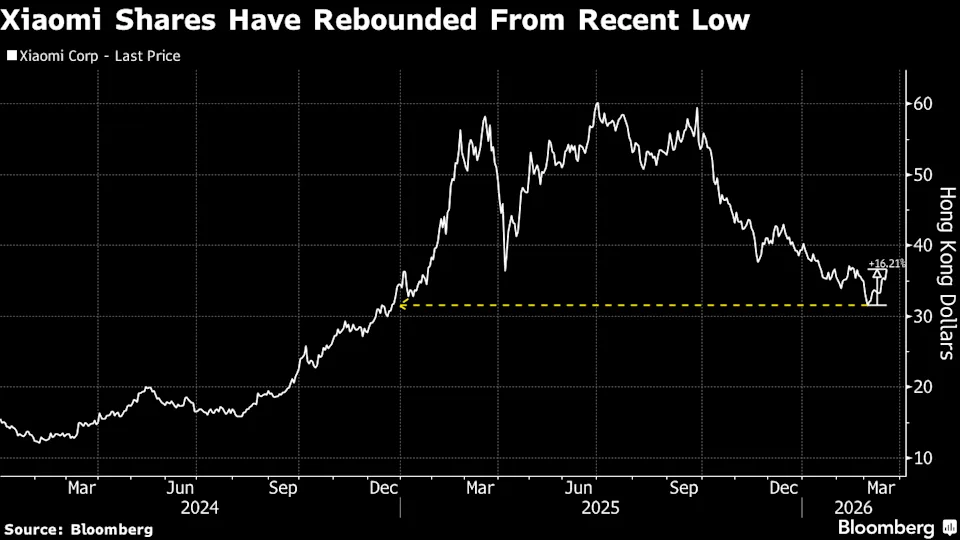
The Hong Kong-listed stock jumped as much as 5.8%, making it the best performer on the Hang Seng Tech Index — which itself fell more than 2% after Tencent Holdings Ltd. earnings disappointed investors and as the war in Iran escalated. AI-fueled optimism adds to a recent recovery in Xiaomi shares following a 45% plunge, which had been driven by concerns that surging memory prices would erode its profitability.
Xiaomi has stepped up its AI efforts to catch up to the frenzy around agentic AI tool OpenClaw as interest in China surges. It rolled out models including MiMo V2 Pro this week, an in‑house AI system designed for agent‑based applications. Earlier this month Xiaomi said it had begun testing of the AI agent miclaw for mobile devices. Chief Executive Officer Lei Jun said Xiaomi will invest more than 16 billion yuan ($2.3 billion) on AI research in 2026.
“The new model launches should reinforce Xiaomi’s position as a top-tier developer of foundation models,” Goldman Sachs analysts including Timothy Zhao wrote in a note. “While intensified R&D investments will drag near-term profit, consistent outcome deliveries should encourage the market to view Xiaomi as a physical AI leader with proprietary AI, OS and chipset capabilities, and look beyond near-term group P/E valuation for longer-term value creation.”
The Beijing-based company will also unveil the updated version of its SU7 sedan in Beijing later Thursday, enhancing hardware and safety features to maintain its competitiveness in the crowded EV market. The car business is increasingly important as a growth engine for Xiaomi, especially as rising component costs weigh on the outlook of the global smartphone market.
Short sellers who’ve profited from Xiaomi’s recent struggles with surging memory chip prices may be feeling uneasy after the stock’s sharp rally this week. Short interest as a share of free float held around 7.3%, up from just 2% in late September, according to data from S3 Partners LLC.