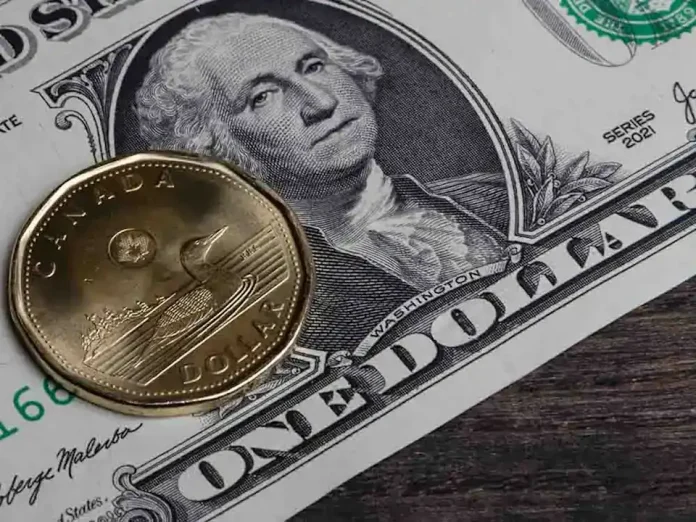
Currency analysts at Scotiabank say it’s possible the Canadian dollar could rise to as high as 78 cents U.S. against the greenback by the end of this year instead of 2026 on a deteriorating outlook for the loonie’s American counterpart
“We remain a bit more bullish on the CAD (Canadian dollar) outlook, bearish on the U.S. dollar than the Street consensus,” Shaun Osborne, chief FX strategist at Scotiabank Global FX Strategy, said during a webinar.
The Canadian dollar has clocked a strong run over the last six months and is up 6.2 per cent against the U.S. dollar. Thursday alone, the loonie rose 0.5 per cent to an intraday high of 73.76 cents U.S.
Conversely, the U.S. dollar index, which measures the greenback’s performance against a basket of other major currencies including the Canadian dollar, has fallen nearly 11 per cent in its worst performance over six straight months since the 1970s, and its worst first-half showing since 2017.
“A six-month run (down) is pretty unusual,” Osborne said. “It does seem quite likely that even though we’ve seen this significant depreciation … in the past few months. That trend is very likely to continue.”
Osborne forecast to the policies and actions of United States President Donald Trump, including his massive tax-cut bill, which is projected to increase U.S. debt by US$3.3 trillion. The bill passed its final legislative test on Thursday and was due to be signed into law by Trump by his July 4 deadline.
“It seems quite likely that we will see persistent deficits in the U.S. Over time we have seen a pretty strong relationship between the situation on the deficit side and the evolution of the U.S. dollar,” he said.
Osborne also said the “potential erosion of Fed (U.S. Federal Reserve) independence is another worry for investors at a time where inflationary pressures still seem to be simmering,” which is another headwind for the U.S. dollar’s performance.
On Wednesday, Trump said in a Truth Social post that Federal Reserve chair Jerome Powell was “too late” and “should resign immediately.”
The U.S. dollar could decline further if Trump decides to name a “shadow” chair who is amenable to the president’s calls for lower interest rates.
“Given the exceptional returns from the U.S. economy and assets over the last 10 to 15 years, we think we are in a position where global investors have become over-indexed to U.S. dollar assets and they are wondering if that situation is wise and whether it should continue,” Osborne said.
There were signs in April that investors were thinking exactly that when the largest net outflow from U.S. Treasuries by Canadian investors ($57.8 billion) was recorded — also bad news for the greenback, but a definite boost to the loonie.
On the plus side for the Canadian dollar, a TD Securities report from last week said if Canadian pension funds decide to repatriate U.S. investments to hedge against greenback losses, that flow of money back into Canada could provide a significant lift.
TD Securities is currently calling for the Canadian dollar to rise 76 cents U.S. by December.
Added Karl Schamotta, chief market strategist at Corpay Currency Research: “As long as the slow-motion flight from the dollar continues, the loonie stands to benefit.”