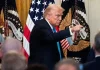
As President Trump prepared for Sunday talks in Scotland with European Commission President Ursula von der Leyen, Commerce Secretary Howard Lutnick said the EU has to open its markets for US exports if it wants to convince Trump to reduce the 30% tariff he’s threatened to put in place August 1.
“The question is, do they offer President Trump a good enough deal that is worth it for him to step off of the 30% tariffs that he set,” Lutnick told “Fox News Sunday,” adding that Trump was looking to increase access for U.S. firms.
On Friday, Trump put the odds of a trade deal with the European Union at “50-50,” even as negotiators from both sides have expressed optimism about reaching a deal before the Aug. 1 deadline.
“I would say that we have a 50-50 chance, maybe less than that, but a 50-50 chance of making a deal with the EU,” Trump told reporters before departing on a trip to his golf course in Scotland. European Commission President is set to meet Trump in Scotland this weekend in a bid to secure a deal.
Trump also said that letters dictating tariff rates for over 200 countries would go out soon while his administration works to clinch deals with larger trade partners, including the EU, India, and Canada. Trump said the US hasn’t had a “lot of luck” with Canada and suggested he may impose threatened 35% levies on goods not covered by the US-Canada-Mexico trade agreement.
President Trump last week touted a $550 billion investment in the US that Japan made as part of trade negotiations “to lower their tariffs a little bit,” as he described it. On Saturday, Japanese trade negotiator Ryosei Akazawa suggested the money could be used to help finance a Taiwanese chipmaker building plants in the US, Reuters reported.
Akazawa did not name a specific Taiwanese company, but in March, Taiwan’s TSMC announced a $100 billion investment in the US, on top of plans to build three plants in Arizona, one of which is already operating.
“For example, if a Taiwanese chipmaker builds a plant in the U.S. and uses Japanese components or tailors its products to meet Japanese needs, that’s fine too,” he said.
Trump announced the deal on Tuesday, which includes a 15% tariff on imported goods along with the $550 billion Japanese investment. However, the sides do not seem aligned on profit sharing, with Japan seeking a split based on contributions, while the US says it would keep 90%.
In any case, the Japan trade deal may have set a precedent for Trump’s new baseline tariff rate. As the US finalized the deal with Japan and advanced talks with the EU, Trump said tariffs would range from 15% to 50%, with tougher partners facing higher rates.
Trump’s April “Liberation Day” tariffs had set a baseline rate of 10% on all US trading partners.