US companies are poised to boost their debt levels to help fund a $1 trillion wave of acquisitions, a reversal after years of scaling back their borrowings.
Keurig Dr Pepper Inc. this week said it’s buying coffeemaker JDE Peet’s NV and funding the deal with a €16.2 billion ($19.0 billion) bridge loan. AT&T Inc. said on Tuesday it’s buying spectrum licenses from EchoStar Corp. for about $23 billion, a move that will probably be at least partly funded with bonds.
Companies have broadly been lifting their debt loads relative to earnings, with that leverage ratio in the second quarter close to its highest level since 2021. Corporations’ willingness to lever up represents a shift in their thinking.
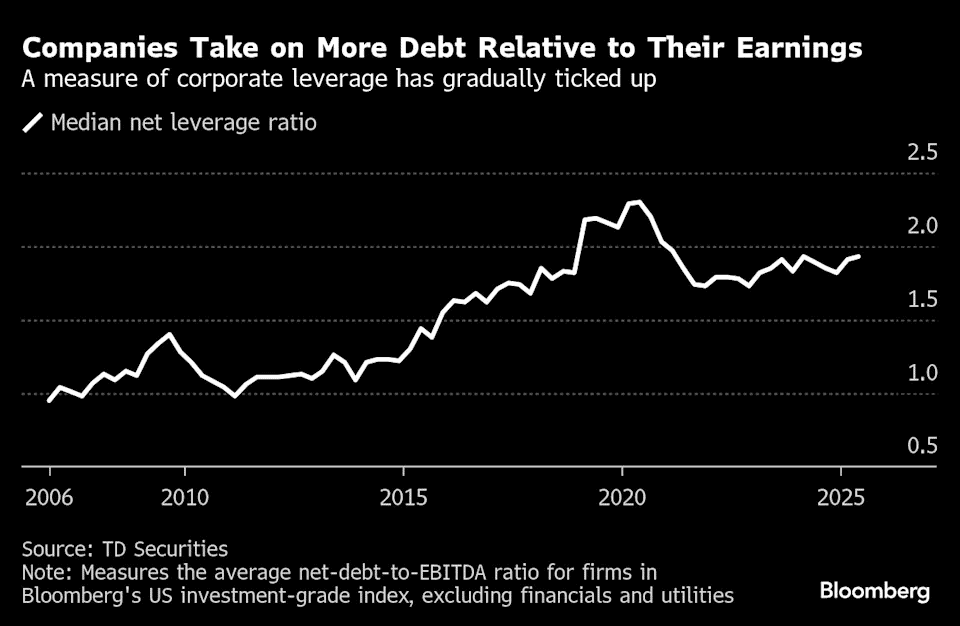
As the Federal Reserve started raising rates in 2022 and debt became more expensive, many companies sought to cut their borrowings. AT&T’s debt load steadily declined through the first quarter of 2025, for example.
But the Fed is moving closer to a renewed round of rate cutting, potentially lowering the cost of borrowing. The Trump administration is seen as more likely to grant regulatory approval for corporate tie-ups. Executives are gaining more confidence that the stock market volatility has ebbed, while questions about corporate tax rates have been clarified. All of that has improved the conditions to make acquisitions.
“We had a tremendous amount of uncertainty in the first part of the year,” said Hans Mikkelsen, a credit strategist at TD Securities. With some of it resolved, he said, “that’s really what’s unleashing all this M&A.”
For much of this year, credit markets have been starved of acquisition financings, debt sales that not only provide fresh supply but also often include long-dated bonds. Money managers are eager to buy longer-term securities in a world of historically elevated yields that may soon decline. This year, M&A-related financings account for around 10% of high-grade debt sales, compared with 15% in 2019, according to JPMorgan.
Syndicate professionals expect many of the recently announced deals to make their way to the debt markets later this year or in 2026, since companies typically wait until their acquisitions close to refinance bridge loans with permanent financing. Keurig Dr Pepper’s tie-up is expected to close in the first half of next year, while AT&T said it expects to finalize its transaction in mid-2026.
It’s possible, however, that some firms choose to sell debt before completing their deals, especially if credit spreads stay tight and borrowing costs fall further. The companies could include a condition known as special mandatory redemption language, which would let them buy the bonds back at a small premium if their acquisition doesn’t go through.
“Particularly if we see a gap lower in rates, there’ll be more incentive for those companies to de-risk the debt component of those acquisition financings,” said Ryan Morrell, co-head of investment grade debt capital markets at PNC Financial Services Group Inc.
Either way, more debt-fueled acquisitions are probably coming at high-grade companies, teeing up a busy 2026.
“Now a few months after that fear episode in April, we are getting a restart of animal spirits,” said Piers Ronan, co-head of debt capital markets and syndicate at Truist Securities. “That, I’m sure, will continue into 2026 and hopefully beyond.”