(Bloomberg) — Treasury Secretary Scott Bessent predicted a “pretty big breakthrough” in the next round of trade talks with China, even as the Trump administration takes steps to support American farmers hurt by a decline in Chinese purchases of soybeans.
“The most important thing we’re going to see” is a pull-aside meeting of Presidents Donald Trump and Xi Jinping at a regional summit in South Korea scheduled for late October, Bessent said in an interview on CNBC Thursday. He added that his own parallel trade talks with Vice Premier He Lifeng, “which would be our fifth round of talks, should show a pretty big breakthrough.”
Purchases of agricultural products, and particularly soybeans, have emerged as a key point of contention between the world’s two largest economies. Earlier this year, China used its dominance of vital rare earths to help force Trump into easing export controls on certain goods to China. That came on the heels of an agreement to reduce the punitively high tariffs that both sides had levied on each other.
Beijing’s new bargaining chip is an import ban on US soybean, Lu Ting, chief China economist at Nomura Holdings Inc., wrote in a note to clients. “US soybeans now are not that important to China, and that’s why Beijing can afford to use the import ban as a bargaining tool.”
China has called for the US to cancel “unreasonable” tariffs and create conditions for an expansion in trade. Xi is also renewing a push for the US to change a decades-old phrase describing its stance on Taiwan to declare it opposes independence, Bloomberg reported this week, citing a person familiar.
On a call with Trump last month, Xi urged the US president to avoid restrictive trade measures and called for a “fair and non-discriminatory” environment for Chinese companies to invest in the US. Trump said at the time there had been progress on trade, fentanyl, the war in Ukraine and the TikTok deal.
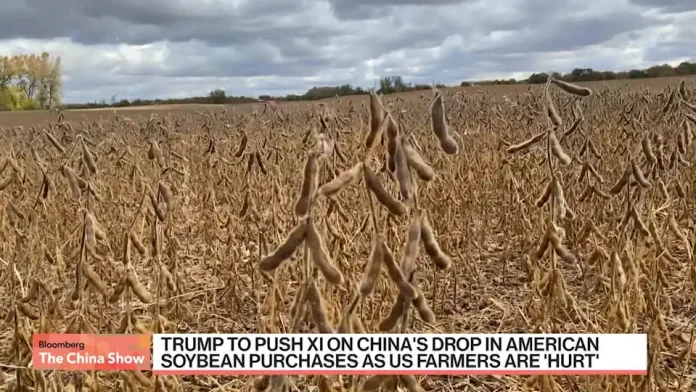
Beijing has turned to soybeans as leverage just as the harvest is coming in. While last year China, the world’s biggest buyer, sourced a fifth of its imports from the US, it hasn’t bought a single soybean cargo from the current harvest. Bessent called this year’s yield so big that “we may run out of storage.”
Bessent said he had a meeting in the Oval Office on Wednesday with Trump and Agriculture Secretary Brooke Rollins, and that news would be coming next Tuesday on support for American farmers, and the soy sector in particular.
Truce Expiration
“It’s unfortunate the Chinese leadership has decided to use the American farmers, soybean farmers, in particular, as a hostage or pawn in the trade negotiations,” Bessent said.
The upcoming negotiations will occur before the scheduled Nov. 10 expiration of a truce on the highest tariff levels from earlier this year, Bessent said.
During the June round of talks, which took place in a mansion near Buckingham Palace, the US agreed to ease some of its export controls on sensitive technology to China while Beijing agreed to speed up shipments of rare earth metals critical to US auto and defense companies.
Despite that truce, China has curtailed purchases of US soybeans, stoking concern not just in the agriculture industry but among politicians representing farming districts.
“We want to sell soybeans to China,” said Senator John Hoeven, a Republican who represents the key soybean-producing state of North Dakota. “We are concerned that the Chinese are really going to the South American market and cutting out our farmers. But they’re doing that on purpose as leverage in this negotiation regarding tariffs.”
Hoeven likened the current standoff to a similar use of soy as leverage by China in Trump’s first administration. In the end, Trump secured $50 billion in agricultural sales, he said. “As the president said, he’s going to keep our farmers in the game until we get that done.”
Trump on Wednesday voiced support for farmers in a post on Truth Social, singling out soybean farmers and saying that China “is, for ‘negotiating’ reasons only, not buying.” He also appeared to suggest that the US government could take some of the revenue it has collected from higher tariffs to provide support to farmers who have been affected by the decline in sales.
Bessent himself owns farmland in North Dakota, which he is trying to sell as part of an ethics agreement reached with the government earlier this year.