(Bloomberg) — President Donald Trump decided to let Nvidia Corp. sell its H200 artificial intelligence chips to China after concluding the move carried a lower security risk because the company’s Chinese archrival, Huawei Technologies Co., already offers AI systems with comparable performance, according to a person familiar with the deliberations.
Administration officials who weighed whether to clear Nvidia’s H200 had considered multiple possible scenarios, factoring in the views of national security hawks in Washington, said the person. Options ranged from exporting zero AI chips to China to allowing exports of everything to flood the Chinese market and overwhelm Huawei. Ultimately the policy backed by Trump called for clearing H200s to China while holding back the latest Nvidia chips for American customers, the person said.
The move would give the US an 18-month advantage over China in terms of what AI chips customers in each market receive, with American buyers retaining exclusive access to the latest products, the person said. White House officials concluded that pushing the H200 into China would prod Chinese AI developers into building on the US tech ecosystem rather than turning to offerings from Huawei or other local chipmakers.
Trump’s decision this week provoked an immediate backlash from lawmakers who argued that Washington was providing Beijing the tools it needs to develop next-generation AI. The H200 is on paper at least a generation ahead of anything offered by Chinese designers from Huawei to Cambricon Technologies Corp. and Moore Threads Technology Co. The country at present also requires more chips than local firms can supply.
A Guide to Nvidia Chips at Center of US-China Rivalry: QuickTake
Still, Beijing — in its quest to wean the nation off American technology — has in the past strongly discouraged Nvidia adoption particularly among state-affiliated corporations and agencies.
“DeepSeek should have been a wakeup call about the dangers of selling advanced semiconductor chips to the CCP,” Representative Michael McCaul said in an email. “Using less powerful NVIDIA chips, China developed the most advanced open-source models on the planet. I shudder to think of what they might do with more advanced hardware like the H200 chips.”
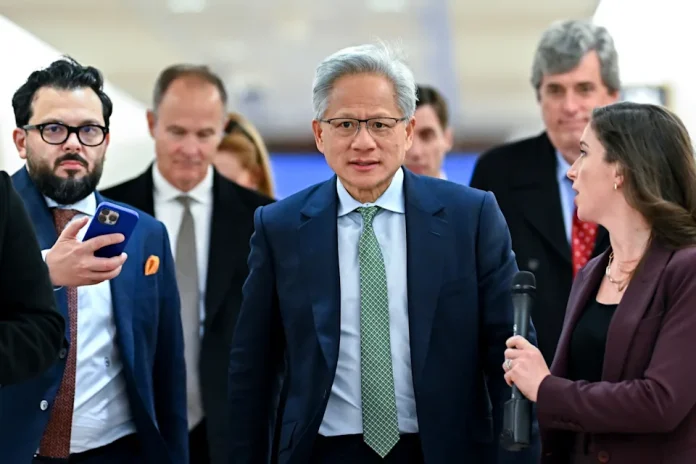
Trump’s decision capped weeks of deliberations with advisers about whether to allow H200 exports to China and came days after a private meeting in Washington with Nvidia Chief Executive Officer Jensen Huang, who has pressed for relief from US export controls. In his Truth Social post announcing the move, Trump said that shipments would only go to “approved customers,” and that chipmakers such as Intel Corp. and Advanced Micro Devices Inc. would also qualify.
Underpinning the move was an assessment that Huawei can compete far more closely with Nvidia than the US has acknowledged. White House officials focused on a Huawei AI platform known as CloudMatrix 384 that relies on the company’s newer Ascend chips, the person said. Officials found that CloudMatrix 384 performed as well as a similar Nvidia system known as NVL72 that uses the US company’s most advanced Blackwell-design chips, according to the person, who spoke on condition of anonymity to discuss sensitive matters.
Adding a sense of urgency, the person said, was a conclusion by US officials that Huawei would be capable in 2026 of producing a few million of its Ascend 910C accelerators, a chip designed specifically to compete with Nvidia’s product line. That compares with a US estimate, given in June, that the Shenzhen-based company would be able to make just 200,000 of the Ascend line this year.
Spokespeople for the Commerce Department and Nvidia had no immediate comment. “The Trump administration is committed to ensuring the dominance of the American tech stack – without compromising on national security,” said Kush Desai, a White House spokesman.
It’s unclear whether Chinese companies will embrace the H200 as eagerly as Trump administration officials envision. Trump said he told his Chinese counterpart, Xi Jinping, about the move and that Xi had responded favorably. But official Chinese government channels have yet to say publicly whether the H200 would be welcomed, and the Financial Times reported Tuesday that authorities in Beijing were preparing to limit access to H200 chips to certain firms to preserve the country’s drive for tech self-sufficiency.
Nvidia, the world’s largest publicly traded company, has said it’s not currently forecasting any revenue from the China data center market. Huang has pegged that lost opportunity as reaching as much as $50 billion this year.
In August, Nvidia won US approval to export its H20 chip to China but sales were stymied by authorities in Beijing, who told domestic customers to shun American products and rely instead on processors made by Chinese companies. Huawei is preparing to double its chip production to make about 600,000 of its marquee 910C chips next year, Bloomberg has reported, though recent teardowns suggest the company is still relying on foreign hardware from Taiwan Semiconductor Manufacturing Co. and Samsung Electronics Co. Beijing-based Cambricon also plans to triple its output.
Clearing a path for H200 exports marks a victory for Nvidia in its campaign to get Trump and Congress to relax export controls that have kept the company from selling its AI chips to the world’s largest semiconductor arena. Huang has forged a close relationship with Trump since the November 2024 election and has used those ties to make his case that restrictions only boost Chinese domestic champions like Huawei.
Trump’s blessing for the H200 is seen as a compromise from Nvidia’s earlier push to sell its more advanced Blackwell chips to Chinese customers, another person familiar with the matter said prior to the announcement. Nonetheless, it provoked an immediate backlash from Democratic senators including Elizabeth Warren, who warned of a “colossal economic and national security failure” in providing Beijing the tools it needs to develop next-generation AI.
Easing restrictions on the H200 and similar-grade chips risks giving an edge to Chinese companies like DeepSeek that compete with the US in artificial intelligence, said Chris McGuire, a senior fellow for China and emerging technologies at the Council on Foreign Relations.
“This is very bad for the export of the full AI stack across the world. It actually undermines it,” said McGuire, who served in the White House National Security Council under President Joe Biden. “At a time when the Chinese are squeezing us as hard as they can over everything, why are we conceding?”