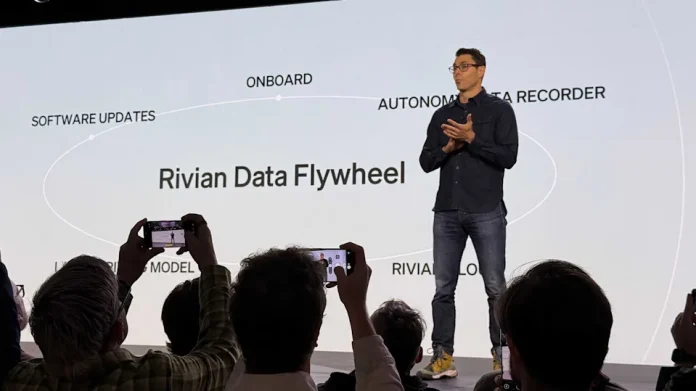
PALO ALTO, Calif. — Rivian (RIVN) on Thursday rolled out the future of its tech stack at its first-ever Autonomy & AI Day, encompassing a new autonomous driving framework powered by custom silicon, as well as an AI assistant using Rivian’s own Unified Intelligence.
The company said software advancements from its new Autonomy platform and Large Driving Model (LDM), an autonomous model trained similarly to a large language model (LLM), will bring Universal Hands-Free (UHF) assisted driving to second-gen R1 vehicles.
Rivian said the feature will be available via subscription — dubbed Autonomy+ — in early 2026 for a one-time charge of $2,500 or $49.99 per month.
Shares fell over 6% on Thursday.
Rivian’s current advanced driver assistance features include adaptive cruise control with a lane-keeping assistant.
Rivian’s future lies in its Autonomy platform and Large Driving Model, the company said.
“Our updated hardware platform … will enable us to achieve dramatic progress in self-driving to ultimately deliver on our goal of delivering L4 [autonomous driving],” CEO RJ Scaringe said.
Scaringe used an example where a user will eventually be able to tell their Rivian vehicle to go pick up their kids — on its own.
While hands-free driving is offered by GM (GM), Ford (F), and, of course, Tesla (TSLA), Rivian detailed plans to continuously improve the capabilities of its Autonomy platform for its second-generation R1 and future R2 vehicles, with a path toward eventual Level 4 self-driving capabilities — or full autonomy — though the company did not give a target date for the rollout.
Level 4, currently featured in Waymo’s robotaxis, is the tipping point when it comes to vehicles that can operate fully autonomously in specific geographic regions.
Waymo’s robotaxis are expanding into new territories, as is Tesla’s robotaxi platform, though Tesla is not yet as close to autonomy as Waymo.
Custom silicon
Rivian is also taking a page out of Tesla’s playbook by developing its own custom processor, a key ingredient for its Autonomy platform.
Rivian said the first-generation Rivian Autonomy Processor (RAP1) is a custom 5nm processor that integrates processing and memory onto a single multichip module.
RAP1 will power the company’s third-generation autonomy computer, the Autonomy Compute Module 3 (ACM3).
In addition to ACM3, Rivian plans to integrate lidar into future R2 models, a notable difference from Tesla’s vision-only full self-driving (FSD) product. Rivian said lidar will augment the company’s multimodal sensor strategy, providing three-dimensional spatial data and redundant sensing and improving real-time detection on the road.
Rivian said its Gen 3 Autonomy hardware, including ACM3 and lidar, is currently undergoing validation. It expects to ship on R2 models starting at the end of 2026, which could mean that the first R2s rolling out of the factory in the first half of 2026 would feature older hardware.
Rivian also unveiled its Rivian Unified Intelligence (RUI) platform, which will feature LLM-based products, such as chatbots, to aid drivers with small tasks while also helping to create new features, improve service infrastructure, and predict maintenance needs.
The chatbot will be called the Rivian Assistant, a voice-based product launching in early 2026 on Gen 1 and Gen 2 R1 vehicles. Rivian said the RUI connects with third-party apps like Alphabet’s (GOOG, GOOGL) Google Calendar, which was named as the first integration.
The platform will be model agnostic, meaning it won’t favor Google’s Gemini or OpenAI’s (OPAI.PVT) ChatGPT.
The company previously used Amazon (AMZN) Alexa integration for smaller tasks, but the built-in-house RUI will allow integration with other LLMs.