China declared on Thursday that it was now the world leader in research and development for artificial intelligence as well as other key fields such as quantum technology, and vowed to accelerate efforts to achieve greater tech self-reliance.
That claim was made in one of the government reports issued at the opening session of the National People’s Congress, China’s rubber-stamp parliament.
“China now leads the world in research and development and application in fields such as AI, biomedicine, robotics and quantum technology, and new breakthroughs were made in the independent R&D of chips,” according to a report by the National Development and Reform Commission.
China and the United States are dueling fiercely for supremacy in key technologies. The battle has led to intense trade friction with both sides placing export controls on key products and resources – advanced chips in the case of Washington and rare earths in the case of Beijing.
HUMANOID ROBOTS AND DATA CENTRES
The report also said China leads the world in terms of open-source AI models, and that the country has emerged as the largest producer of industrial robots and unmanned aerial vehicles.
It said China would nurture future industries such as quantum technology, embodied AI – the tech that powers humanoid robots – and 6G, and promote the commercial and large-scale application of AI in key sectors.
China plans to launch new data centre projects and will coordinate the distribution of computing capacity across the country. It also plans to establish a system for AI security risk prevention and control.
“Beijing is making AI and especially embodied AI a major area of focus,” said Kyle Chan, fellow in Chinese technology at the Brookings Institution think tank.
“Beijing’s goal is to use AI and robotics to boost productivity and performance in a wide range of sectors, from manufacturing and logistics to education and healthcare.”
The report also said that China’s supply of high-quality industry AI datasets had continuously expanded.
By the end of 2025, the average daily queries of large AI models had increased 30-fold compared to the beginning of the year, with the number of users exceeding 600 million, it said.
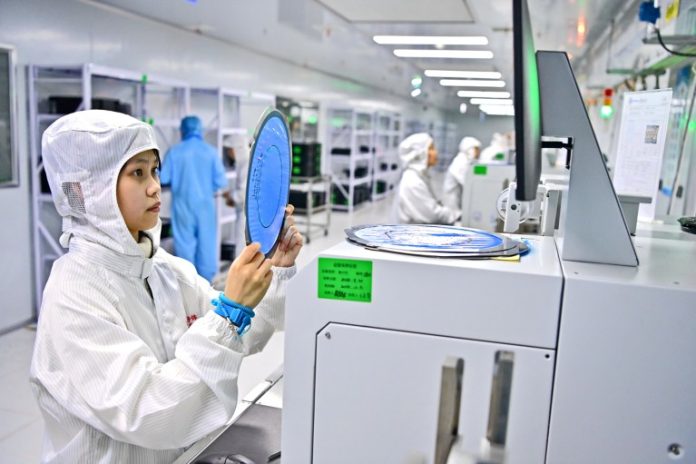
China also pledged to boost still young domestic industries such as semiconductors and aerospace.
Although U.S. tech firms have much more funds to invest than their Chinese competitors, Beijing is counting on its world-leading supply chains, low-cost manufacturing and fast R&D cycles to scale quickly.
There may be limits to that growth though.
U.S. research group Rhodium said in a January report that China’s emerging industries would not generate enough investment to replace traditional industries in a way that would sustain 5% GDP growth over the coming years.