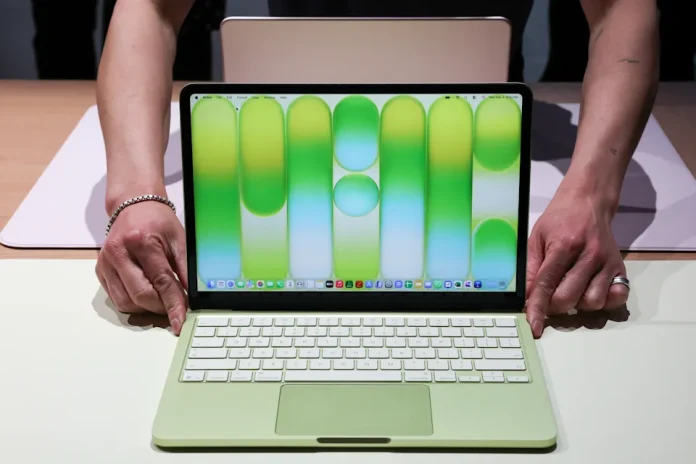
Apple (AAPL) took the wraps off of its long-rumored low-cost MacBook on Wednesday, opening up a whole new market to its traditionally pricy laptops.
The MacBook Neo, which starts at $599, or $499 as part of Apple’s education program, is meant to target schools, students, small businesses, and consumers who want to take a crack at a MacBook but don’t want to spend north of $1,000.
“We’ve been wanting to do a much more affordable MacBook, but it was only until recently where all the stars aligned to allow us to do it,” explained Thomas Boger, VP of Mac product marketing.
Apple didn’t just roll out the MacBook Neo, though. On Tuesday, it also showed off its newly refreshed $1,099 MacBook Air with the company’s M5 chip, as well as its upgraded MacBook Pro, which can be outfitted with Apple’s high-powered M5 Pro and M5 Max chips.
That means Apple now has laptops for everyday consumers in the Neo, those looking for something with a bit more oomph in the Air, and professionals who need serious horsepower in the MacBook Pro.
That’s a price the company hasn’t offered before, which could spell trouble for Microsoft (MSFT) and its Windows-based laptops, not to mention Google’s (GOOG, GOOGL) Chromebooks.
“The refreshed MacBook portfolio is positioning Apple to go on the offensive in the PC market,” Evercore ISI analyst Amit Daryanani wrote in a note to investors following Apple’s announcement.
“In addition, Neo reinforces Apple’s flywheel effect by bringing more price-sensitive consumers into the Mac ecosystem, deepening cross-device engagement through iPhone integration … that could ultimately drive incremental hardware and services monetization,” he added.
A whole new MacBook
The MacBook Neo is unique among Apple’s MacBook lineup for more than just its price point. It’s also the first MacBook to run on an A18 Pro chip, the same kind of processor that powers the iPhone 16 Pro.
“One of the things that is instrumental in making the MacBook [Neo] possible is the fact that we use an A-series processor. And if you’ve been following the evolution of the A-series processor, it’s been getting increasingly more powerful,” Boger said.
According to Shelly Goldberg, vice president of Mac hardware engineering, the power-efficient A-series chip allowed Apple to outfit the Neo without any internal fans to keep it cool.
Toss in 256GB of storage, with the option for 512GB, and 8GB of memory, and the MacBook Neo should be a solid option for everyday web browsing and light iPhone games. It’s designed to be the kind of notebook you’d be equally comfortable bringing to the office or handing off to your kids so they can do their homework.
Goldberg says the Neo isn’t simply a stripped-down MacBook Air or Pro. Instead, Apple looked at the Neo as a wholly new laptop.
“It was like knowing what our target was and understanding what it means to be a Mac and what it means to design and engineer that level of quality, and then knowing what the feature set and the cost goals were starting from a completely blank slate,” she explained.
Those cost goals are what make the Neo a potentially potent threat to Microsoft’s low-cost PCs and Google’s Chromebooks.
Taking on Windows and Chromebooks
For years, schools have opted for the two options, but the Neo’s $499 education price makes it a prime contender in the space.
But it also needs to be able to stand up to the rigors of a typical school day.
“Obviously, we think about repairability, but first and foremost, we think about durability,” Goldberg said.
“The best repair is the one that didn’t have to happen. So, that focus that we have on all of our products carries straight into Neo and the expectations that we have for its performance and the various things that kids or adults might do to their machines,” she added.
“This market, if we just take the US alone, is about 25 million students. Of course, not all of them will get a MacBook Neo, but these are new customers for Apple,” Deepwater Asset Management managing partner Gene Munster said in his Pressure Points podcast following Apple’s announcement.
“Typically, they’ve gotten Chromebooks. Maybe 1 in 5 of them will eventually have one of these products. So, think of this as 5 million in aggregate and … that takes maybe three years to kind of layer in. What you effectively get is that would add a couple billion to revenue for the Mac business,” Munster added.
In 2025, Apple’s Mac business generated $33.7 billion in revenue, up from $30 billion in 2024. That makes it Apple’s fourth-largest segment by total sales, behind the iPhone, which brought in $209.5 billion; Services, which brought in $109.2 billion; and Wearables, which generated $35.7 billion. Apple’s iPad business brought in $28 billion for the year.
“Moving into the $600 range indicates that Apple’s strategy is to expand the macOS installed base and compete more directly with Windows laptops and Chromebooks in education and price-sensitive segments,” International Data Corporation vice president of client devices Francisco Jeronimo wrote in a note following Apple’s announcement.
“By lowering the entry barrier to the Mac, Apple can bring more users into its services and device ecosystem, particularly students and first-time Mac buyers,” he added.
Apple’s Neo comes amid a global memory shortage caused by the worldwide AI data center build-out. Because memory makers can make higher margins on the chips, they’re producing more of them, limiting the amount of memory for consumer electronics.
According to market research firm Gartner, PC shipments could fall as much as 10.4% in 2026, and memory prices could peak at 23% of the total bill of materials for laptops. That, Gartner senior director and analyst Ranjit Atwal wrote in a press release in February, could force PC makers to kill off their sub-$500 laptops by 2028, since they’ll be unable to absorb the additional cost.
But Jeronimo says that could help Apple.
“Lower-entry pricing will therefore help stimulate demand at the entry level while strengthening Apple’s long-term ecosystem strategy,” he explained.
The Neo hits stores March 11, meaning sales will start hitting Apple’s bottom line in Q2, though it’s unlikely we’ll see its full impact until Q3 or later.