President Trump and other Republicans swept into office last year slamming former President Joe Biden’s stewardship of the US government’s energy backstop and promising a change.
Trump pledged during his second inaugural address to “fill our strategic reserves up again right to the top,” which led to an early draft of what became the GOP’s Big Beautiful Bill Act, earmarking more than $1 billion to replenish the government’s Strategic Petroleum Reserve (SPR).
But that allocation was shaved by more than 80% before the bill reached Trump’s desk, a concession to the overall price tag. At the same time, some congressionally mandated oil withdrawals continued, further depleting the reserve.
These two factors have hampered the Trump administration’s efforts to quickly replenish the reserve and left the president with more limited options to counteract rising oil prices as attacks on Iran by the US and Israel shake the global economy.
In total, government data shows that about 413 million barrels are in the reserves as of December. By contrast, then-President Biden oversaw a reserve above 600 million barrels before escalating tensions between Russia and Ukraine precipitated a major drawdown.
For his part, Trump has been downplaying the chances of tapping reserves in response to the recent spike, telling reporters on Saturday, “We’ve got a lot of oil” and suggesting instead he is looking at adding to the reserves “at the appropriate time.”
During a press conference on Monday, Trump reiterated his belief that oil price increases will reverse quickly and promised that if Iran impedes oil flows “they will get hit at a much harder level.”
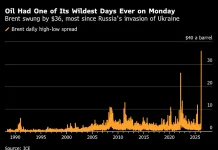
But the increase in oil prices — it was briefly trading above $110 a barrel before yo-yoing on Monday — has led to expectations that withdrawals may eventually be needed.
Rystad Energy chief economist Claudio Galimberti said Monday on Yahoo Finance that prices of $135 per barrel could be possible if the Strait of Hormuz closure persists for several more months.
“We are now in the middle of one of the biggest crises in the energy market I have seen,” Galimberti said.
G7 economy ministers convened Monday to discuss the joint release of emergency oil reserves, but those talks concluded with the French minister saying the group of nations is “not there yet.”
The price of international benchmark Brent crude (BZ=F) and US benchmark West Texas Intermediate crude (CL=F) are now both up more than 30% over the past month with Trump adding in Monday’s press conference that the fighting is “going to be ended soon” but declining to put a timeline on when he hoped to end the ongoing attacks.
Years of decline in reserve levels
The high-water mark of the SPR, established following the 1973–1974 Arab oil embargo, was in 2010, when more than 726 million barrels were held in salt-lined caverns in Texas and Louisiana run by the US Department of Energy.
The reserves then began a decline, dipping below 600 million barrels by the end of 2021 as tensions escalated between Russia and Ukraine. Biden aggressively tapped the reserve after Russia’s invasion, and it hit a 40-year low of about 347 million barrels in June 2023.
Oil levels have slowly rebounded over the 30 months that followed, gradually rising during the remainder of Biden’s term and so far during Trump’s second term. But the pace in both cases is far from what’s needed to replenish the reserves quickly.
Partisan rancor has clouded efforts in recent years, with Republicans lambasting Biden for tapping the reserve but agreeing only on limited additional spending to replenish the energy backstop.
Trump slammed Biden over the weekend, claiming that Biden tapped the reserves “so he could get some extra votes” and adding on social media on Sunday that high oil prices are “a very small price to pay” for the overall goals of the war in Iran.
A series of congressional false starts
After Trump’s inaugural address — when he promised to refill the reserves and that “we will be a rich nation again” — the issue of the SPR became part of negotiations in Congress to draft a reconciliation package.
Sen. Markwayne Mullin of Oklahoma was involved in those energy talks and, in a statement after the bill passed with only Republican votes, touted an allocation of $389 million for the reserve — $171 million for oil purchases and $218 million for maintenance.
He said the money was “getting us back on track to reestablishing our supply.” Left unsaid was how early versions of the bill dedicated far more money.
The initial plan was $1.3 billion for crude oil purchases before Republicans trimmed it in search of cost savings in the mammoth bill.
The Department of Energy has continued working to replenish the reserve, but the pace remains far below what would be needed to get it back to full capacity before the end of Trump’s term.
The Big Beautiful Bill Act also canceled some congressionally mandated sales from the SPR, which helped boost reserve levels, but it left in place a larger number of upcoming sales mandated by Congress.
Energy Secretary Chris Wright oversees the reserve. He, like Trump, has downplayed the chances of the reserve being tapped during the current conflict.
In a series of Sunday show appearances, Wright told CNN that high oil prices will be a short-term issue.
“Worst case, that’s a few weeks,” he said. “That’s not months.”
Wright said on CBS that the US would be “more than happy” to tap the reserve but suggested it wouldn’t help in the face of “a logistics issue,” namely a shortage of crude oil for refineries in Europe and Asia.
Democrats, meanwhile, are demanding action. Senate Minority Leader Chuck Schumer recently called for tapping the reserve. It exists, he said, “for moments exactly like this.”