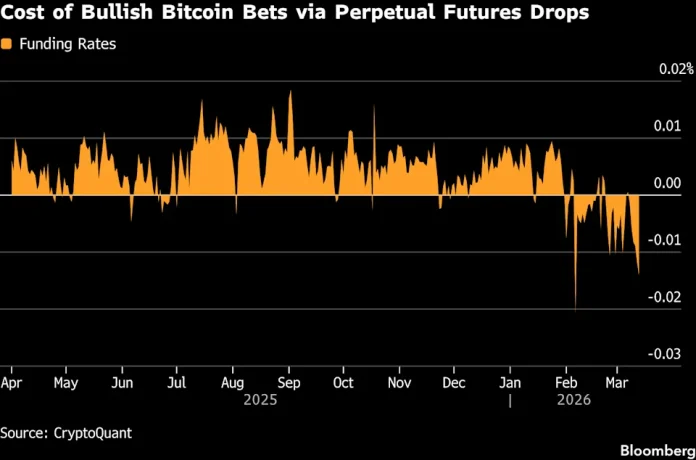
Bitcoin has spent most of this year trapped between $60,000 and $75,000, repeatedly teasing a breakout but never quite delivering one.
The original cryptocurrency is beating stocks and gold since the Iran war broke out, but that says more about how far it had already fallen than where it’s headed. The token is down more than 40% from an October peak.
On Monday, Bitcoin rose as much as 3.6% before paring gains to trade at about $73,600 as of 12:00 p.m. in Singapore. Recently, every rally follows the same script, and invariably they prove short-lived in a market otherwise occupied by gyrations in oil, metals and commodities.
“You see the pattern. Market goes up a bit, open interest builds, funding rates tilt negative on Bitcoin, then we squeeze higher,” said Jasper De Maere, desk strategist and OTC trader at Wintermute, a crypto market-maker. A negative funding rate suggests short-sellers are paying a premium to maintain their positions, suggesting bearish market sentiment.
Compared with late 2025, when Bitcoin oscillated for months between $85,000 and $95,000, trading today is thinner, he added. And that makes the token more vulnerable to sudden price swings.
Bitcoin began a months-long slide in October, just days after touching a record of above $126,000. Some $19 billion in leveraged crypto bets were wiped out on Oct. 10. Since then, prices have ground steadily lower, with conviction notably absent from each fleeting rebound.
It’s a pattern seen in previous crypto bear markets: a sharp selloff, a 20% retracement, and then a stall, according to Andreja Cobeljic, head of derivatives trading at AMINA Bank. “We don’t have the momentum to break out,” he said.
For now, the interest lies elsewhere.

Crude oil surged nearly 70% in the days after the US-Israel escalation with Iran, jumping from about $70 a barrel to as high as $120 before settling near $100. Aluminum is near record highs. Gold has remained relatively flat since the Iran strikes began, weighed down by a stronger dollar and rising yields, after rallying 65% last year — a period in which Bitcoin retreated.
It all amounts to a broad rotation into hard assets that’s left digital alternatives languishing.
Jeff Currie, chief strategy officer at Carlyle Energy Pathways, drew a comparison with the commodity boom that followed the dot-com bubble, a period he described as “the revenge of the old economy.” This time around, he called for holding HALO assets — heavy assets, low obsolescence. “I want to own metal, I want to own gold, I want to own oil,” he said in a Bloomberg TV interview.
The thesis is simple. Global supply chains are strained — not just for crude, but for gas, fertilizers, petrochemicals and metals. Refinery attacks and shipping risks around the Strait of Hormuz could take months to unwind.

For Bitcoin, Cobeljic warns the risks extend beyond the Middle East. Private credit strains, sticky inflation and limited room for central bank easing could trigger another shock. His base case is a short-lived relief rally followed by another cyclical downswing, alongside a rotation toward commodities and other inflation hedges.
Even in crypto markets, tokens designed to mimic commodity prices are sapping flows. Crude is currently among the most traded contracts on Hyperliquid, a venue offering round-the-clock trading. If volatility is the product, energy and metals are delivering it.
To be sure, Bitcoin is up since the Iran conflict began, while equities have sold off. That suggests a maturing asset capable of diverging from traditional risk markets, said Karl Naim, chief commercial officer at XBTO. Data compiled by Bloomberg show a pick-up in demand for Bitcoin exchange-traded funds, with investors pouring in more than $2 billion over three consecutive weeks of net inflows.
For now, though, Bitcoin isn’t keeping pace with HALO assets. In a market captivated by the supply of metals and oil, hard-coded scarcity alone may not be enough to move the needle.