The Federal Reserve held interest rates steady for the second consecutive policy meeting this year, amid a surge in oil prices and increased economic uncertainty, as officials projected one rate cut for the year.
The central bank voted in a split decision on Wednesday to hold its benchmark interest rate in the range of 3.5% to 3.75%. Fed governor Stephen Miran disagreed with the decision, preferring to cut rates by a quarter percentage point.
Fed officials still see just one rate cut this year, the same as projected in December, as inflation remains a full percentage point above the central bank’s 2% goal with oil gushing higher, but the job market flashes yellow, raising questions about its stability.
The breakdown on future cuts, according to the Fed: Seven officials see no cuts this year, while seven see one cut, two see two cuts, two see three cuts, and one sees four cuts.
Fed officials acknowledged uncertainty emanating from the war in Iran, stating that “the implications of developments in the Middle East for the US economy are uncertain.”
New outlook: Higher growth, higher prices
Against that backdrop, officials revised their outlook for economic growth higher by a tenth of a percent, with inflation higher on both a headline and “core” basis, which excludes volatile food and energy prices.
Headline inflation is now seen rising 2.7%, compared with 2.4% previously. On a core basis, officials see inflation at 2.7%, compared with 2.5% previously.
A reading on the Federal Reserve’s preferred inflation gauge for January — the Personal Consumption Expenditures index on a core basis — before the Iran war hit a two-year high of 3.1%.
The Fed sees the economy growing 2.4% this year, up from 2.3% previously. The unemployment rate is expected to hold steady at 4.4%, with no significant weakening of the job market in the forecast despite volatile job figures to start the year.
Officials acknowledged recent volatility in labor market data but also focused on the stability of the unemployment rate. They removed language that the job market had shown signs of stabilization and reiterated that job gains have remained low, while noting the unemployment rate has been “little changed in recent months.” In January, jobs spiked by 126,000, followed by a plunge in payrolls of 92,000 in February, leaving the unemployment rate little changed at 4.4%.
Policymakers reiterated that “in considering the extent and timing of additional adjustments to the target range for the federal funds rate, the Committee will carefully assess incoming data, the evolving outlook, and the balance of risks.”
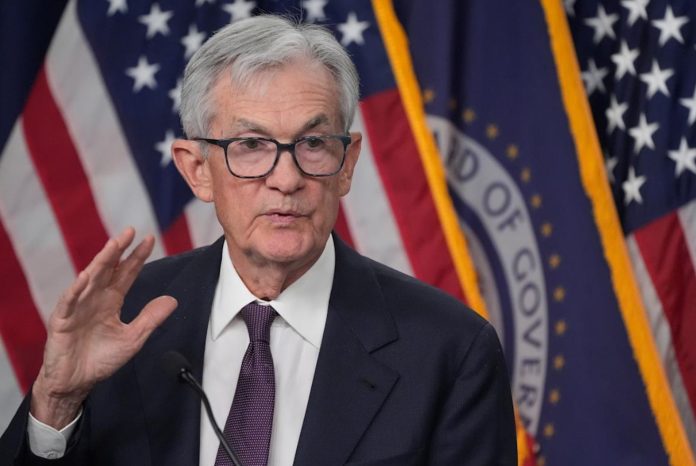
In a press conference following the meeting, Fed Chair Jerome Powell emphasized the extra uncertainty clouding policy moves, particularly from the spike in oil prices.
“The thing I really want to emphasize is that nobody knows. You know, the economic effects could be bigger, they could be smaller, they could be much smaller or much bigger. We just don’t know,” he said.
“If we have a long period of much higher gas prices, that’s going to weigh on consumption, weigh on disposable personal income, and it will weigh on consumption,” Powell added. “But we don’t know if that’s going to happen.”
Powell says he’ll stay at Fed until investigation concludes
This was Powell’s second-to-last policy meeting at the helm, assuming President Trump’s nominee to replace him, Kevin Warsh, is confirmed by the time Powell’s term is up on May 15.
Trump has continued to pound the central bank to cut rates, saying this week that “a third grader would cut rates now.”
Powell’s tenure is winding down as the central bank contends not only with new shocks to oil markets and the job picture, but also with ongoing tension between the Fed and the White House.
Last Friday, a federal judge threw out two subpoenas that were part of a criminal probe the Justice Department opened in January into whether Powell lied to Congress about cost overruns at the Fed headquarters in Washington. US Attorney Jeanine Pirro has vowed to appeal the ruling.
The appeal could drag out the confirmation process for Warsh. North Carolina Republican Sen. Thom Tillis, who sits on the Banking Committee and supports Warsh’s nomination, has vowed to hold up the process until the probe is dropped.
Powell said Wednesday that if Warsh is not confirmed by May 15, he will remain as chair pro tem until a new chair is seated.
“That is what the law calls for,” Powell said, adding that he also intends to stay on the board “until the investigation is well and truly over with transparency and finality.”
He said he has not decided whether to remain on the Fed as a governor once a new chair is in place and the investigation is concluded.