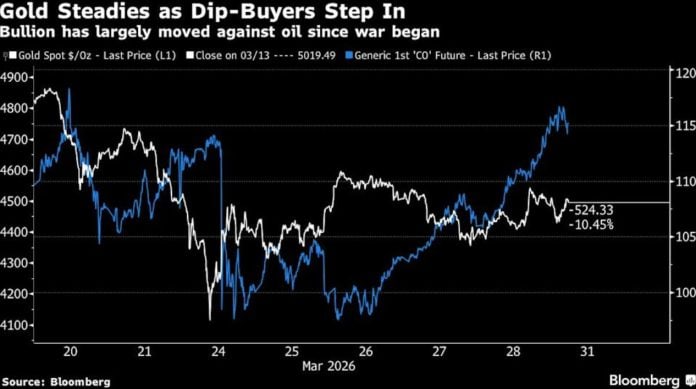
Gold (GC=F) extended its first weekly gain since the Middle East conflict began, as dip-buyers supported prices while the market awaited clarity on the duration of the conflict.
Bullion rose as much as 1.3% to trade above $4,500 an ounce, showing resilience despite a continued rise in oil prices and downturn in equities. That’s an indication that investors stepped in to take advantage of prices that have been dragged down by the war over the past month as inflation worries rise and prospects for interest-rate cuts fade.
The entry into the conflict of Iran-backed Houthis at the weekend signaled an escalation, as did the arrival of more US troops in the region. Even as Pakistan, Egypt, Saudi Arabia and Turkey met to seek a path out of the war, Iran attacked aluminum smelters in Bahrain and the United Arab Emirates, and parts of Tehran lost electrical power after Israeli missile strikes.
The developments have raised concerns of a prolonged conflict that could lead central banks to sell gold and hike interest rates to tame inflation. That, along with a liquidity squeeze in the broader market, have brought gold about 14% lower since the war began at the end of February.
However, rate-hike expectations may be moderated by the risk of a sharp slowdown in an already sputtering economy. Some of the largest fund managers on Wall Street say financial markets are underestimating the risk of economic downturn, which would ultimately push Treasury yields lower. That would reduce the opportunity cost of holding gold and makes the precious metal more attractive.
“Gold could remain vulnerable” in the short term, said Alexandre Carrier, a portfolio manager at the DNCA Invest Strategic Resources Fund, citing the risk of more central-bank selling and the liquidation of positions by investors.
Elevated central-bank buying has been a pillar of bullion’s rally over the last couple of years, but Turkey’s central bank bucked this trend during the first two weeks of the war as it sold and swapped about 60 tons of gold worth more than $8 billion. Many countries that have accumulated the metal are also energy importers, so rising oil prices means fewer dollars are available to be recycled into gold.
Spot gold rose 1.1% to $4,541.21 an ounce at 2:52 p.m. in Singapore. Silver climbed 1.3% to $70.70. Platinum and palladium also advanced. The Bloomberg Dollar Spot Index, a gauge of the US currency, was 0.1% lower after adding 0.7% last week.