Intel's huge rally is helping pay for its AI comeback: Chart of the Day
Intel's (INTC) AI ambitions are getting more expensive. Its 165% rally this year is helping foot the bill. The chipmaker raised $20 billion in an upsized stock sale, pricing 210.5 million new shares at $95…
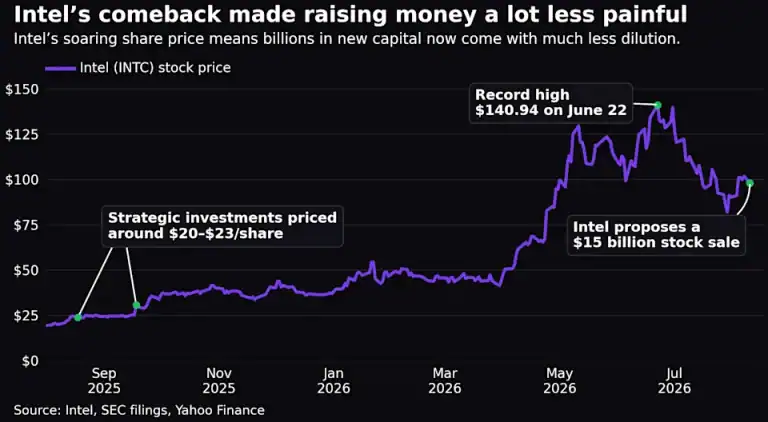
Intel’s (INTC) AI ambitions are getting more expensive. Its 165% rally this year is helping foot the bill.
The chipmaker raised $20 billion in an upsized stock sale, pricing 210.5 million new shares at $95 each. Banks handling the deal can buy another 31.6 million shares, potentially lifting the total to about $23 billion.
That comes with a cost for existing shareholders. Selling new stock causes dilution, meaning each share represents a slightly smaller piece of the company.
Intel’s rally has dramatically reduced that cost.
At the $95 offering price, Intel is selling about 211 million shares to raise $20 billion. At the $20.47 price the US government paid for its Intel stake last year, raising the same amount would have required roughly 977 million shares.
In other words, Intel can now raise the same $20 billion with nearly 80% fewer shares.
In other words, Intel can now raise the same $20 billion with nearly 80% fewer shares.
The stock’s comeback has been remarkable even by the standards of the AI trade. Intel is up about 165% this year, compared with nearly 120% for AMD (AMD) and 17% for Nvidia (NVDA).
And Intel is hardly selling stock at the top. Shares have fallen about 31% from their June 22 record, erasing over $200 billion in market value.
Still, the rally has left Intel with something it badly needs — a much easier way to raise money.
Intel recently lifted its planned spending on factories, equipment, and other long-term investments this year to about $20 billion. The base stock sale now roughly matches that entire amount, though Intel has not said all the money will go toward construction or AI.
“Customers continue to signal a strong and sustainable demand environment, driven by unprecedented investment in AI compute,” Intel said in announcing the offering.
Intel sits in a different part of the AI boom than Nvidia and AMD. Along with selling CPUs used in AI systems, Intel is spending heavily on ways to combine increasingly complex chips and on manufacturing chips designed by outside companies.
That makes Intel another piece of the AI financing story. Big Tech companies have increasingly borrowed to fund their AI build-outs. Intel is tapping shareholders to help build the factories underneath that boom.
Washington adds an unusual wrinkle.
The US government bought $8.9 billion of Intel stock last year at $20.47 a share as part of its push to preserve advanced chip manufacturing in the US. SoftBank and Nvidia also invested around that period, near $20 to $23 a share. Those investments were negotiated at fixed prices rather than Intel’s market price when the deals were announced.
That backing does not shield Intel investors from dilution. Intel itself warns in its SEC filings that more stock sales can reduce existing shareholders’ ownership.
But Washington clearly has an interest in keeping Intel’s factories running and competitive. That makes Intel’s funding challenge different from that of a company left entirely to the mercy of public markets.
A year ago, raising enough money was one of Intel’s biggest challenges. After its monster rally, cash is easier to find.
Spending it well is the harder part now.