Residual Value Guaranties Put Nvidia Behind 4.25GW in Ohio
Nvidia's $105 billion Ohio arrangement with SB Energy covers 4.25 gigawatts of AI capacity for tenant OpenAI — and the chipmaker is supplying residual value guaranties to make it financeable.
Nvidia has agreed a $105 billion AI data center partnership with SB Energy for an Ohio campus totaling 4.25 gigawatts of compute capacity leased to OpenAI, backing the project with residual value guaranties.
Nvidia (NVDA) has attached its balance sheet to one of the largest single build-outs of artificial-intelligence computing capacity yet disclosed: a $105 billion partnership with SB Energy for an Ohio campus designed to house 4.25 gigawatts of AI compute infrastructure, with OpenAI as the tenant. The structure matters as much as the number. Rather than simply selling chips into the project, Nvidia is committing to residual value guaranties — a promise that underpins what the hardware will be worth later, and therefore what lenders will advance today.
Shares were little moved by the disclosure. Nvidia last traded at 226.84, up 0.75% on the day from a prior close of 225.16, inside a session range of 225.02 to 227.92, as of 16:41 GMT on Aug. 17, 2026. The broad market was mixed at the same timestamp: the Nasdaq 100 tracker (QQQ) was up 0.19% at $732.43, while the S&P 500 proxy (SPY) slipped 0.15% to $775.16 and the Dow 30 fund (DIA) fell 0.29% to $535.22.
What a residual value guaranty actually obligates Nvidia to do
A residual value guaranty is a contractual floor on the future worth of an asset. In equipment finance, the party providing it agrees to make the lender or lessor whole if the gear is worth less than an agreed amount at the end of a lease term. For a data center packed with accelerators, that is the single hardest variable to underwrite: nobody knows what a given generation of AI silicon fetches in the secondary market three, five or seven years out, particularly when the company setting the pace of obsolescence is the same company selling the chips.
By supplying that floor, Nvidia converts an uncertain salvage value into something a credit committee can size a loan against. Debt gets cheaper, the equity check shrinks, and a campus that might otherwise stall on financing terms proceeds. That is the commercial logic. The consequence is that the downside risk does not vanish — it migrates. If AI compute demand cools, or if a future architecture makes today’s installed base uneconomic faster than the lease schedule assumes, the shortfall lands with Nvidia rather than with SB Energy’s lenders.
Guaranties of this kind are typically off the income statement until they are called, but they are not invisible. They sit in the contingent-liability and off-balance-sheet commitment disclosures that analysts have been combing through with increasing care as AI financing structures grow more elaborate. Investors reading the next filing should look for the maximum exposure figure, the term over which it runs, and whether the guaranty is capped per tranche or applies across the full $105 billion program.
4.25 gigawatts is a power story before it is a chip story
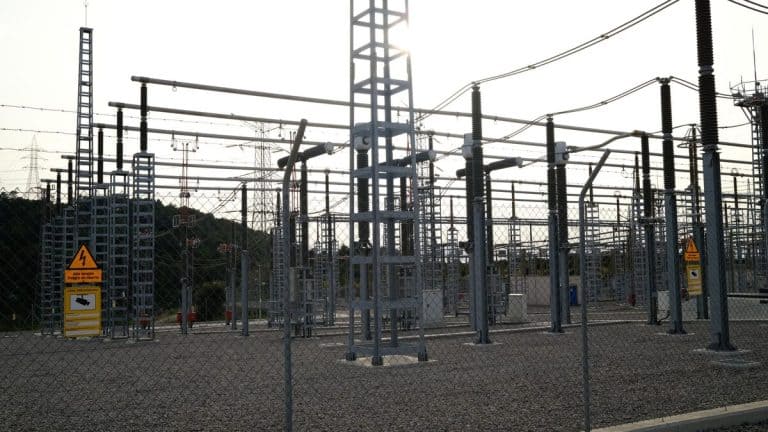
Capacity in this market is now quoted in gigawatts rather than square feet, because electricity — not land or steel — is the binding constraint. A 4.25-gigawatt campus is utility-scale industrial load, the kind that requires interconnection agreements, transmission upgrades and generation planning measured in years. SB Energy’s involvement is the tell: this is a partnership between a compute supplier and an energy developer, and the energy side is the part that cannot be accelerated by writing a bigger check.
Ohio has become a favored destination for exactly this reason, offering land, transmission access and a regulatory environment that has absorbed a wave of hyperscale interest. It also concentrates risk. Very large loads clustered in one grid region raise questions about who pays for the network reinforcement, how ratepayers are insulated, and what happens to the interconnection queue behind the anchor tenant. Those debates play out at state utility commissions, not in earnings calls, and they are the most likely source of schedule slippage.
On the numbers disclosed, the program implies roughly $24.7 billion of committed value per gigawatt — an illustrative figure derived by dividing the headline $105 billion by 4.25 gigawatts, not a reported cost metric. It is a useful yardstick nonetheless for readers trying to compare announcements that mix dollars, megawatts and vague timeframes.
The circularity question investors keep returning to
7 billion of committed value per gigawatt — an illustrative figure derived by dividing the headline $105 billion by 4.
The arrangement, first detailed by GuruFocus, sharpens a criticism that has followed Nvidia through this cycle: the company increasingly helps finance the demand it books as revenue. Here the chain is explicit. Nvidia supplies the accelerators, guarantees their residual value so the campus can be financed, and OpenAI — itself a major customer of Nvidia-powered capacity — takes the space as tenant.
None of that is improper, and vendor financing has a long history in capital-intensive technology. But it changes the risk profile of the equity. A pure component supplier bears demand risk only through its order book; a supplier that also backstops asset values bears it twice, once in the top line and again in the contingent liabilities. In a strong AI capex environment the arrangement is close to costless and highly accretive. In a downturn, the same structure amplifies the hit, because guaranty calls tend to arrive precisely when secondary-market prices for used accelerators are weakest.
The market’s reaction so far suggests investors are treating the announcement as confirmation of demand rather than as a new liability to discount. Nvidia’s modest gain outpaced all three major benchmark funds on the day, but the move was well within a normal session’s range.
What to watch from here
Three things will determine whether this reads well in two years. The first is disclosure: the size, tenor and structure of the guaranty obligation as it appears in Nvidia’s filings, and whether the $105 billion figure represents committed capital, contracted value or a program ceiling to be drawn in stages. The second is the energy schedule — interconnection milestones, generation contracts and any state-level proceedings that touch cost allocation for a load this large. The third is OpenAI’s own funding position, since the tenant’s ability to meet lease obligations across a 4.25-gigawatt footprint is the ultimate credit behind the structure.
Also worth tracking is whether this becomes a template. If residual value guaranties from the chip vendor are what unlocks financing for multi-gigawatt campuses, rivals will be asked for the same, and the AI build-out will become a story about who is willing to warehouse asset-value risk as much as who has the fastest silicon.
Key facts
- NVDA last trade: 226.84, +0.75% (as of 16:41 GMT, Aug. 17, 2026)
- Deal size: $105 billion partnership with SB Energy
- Capacity: 4.25 gigawatts of AI compute infrastructure, Ohio campus
- Nvidia’s commitment: Residual value guaranties supporting project financing; OpenAI is tenant
Frequently asked questions
What is a residual value guaranty?
It is a contractual promise that an asset will be worth at least an agreed amount at a future date. If the actual value falls short, the guarantor pays the difference. In this Ohio arrangement, Nvidia is providing that floor on AI data center equipment, which lets lenders finance the campus on better terms than the uncertain resale value of accelerators would otherwise support.
How large is the Nvidia–SB Energy partnership?
The disclosed figure is $105 billion, covering an Ohio campus designed for 4.25 gigawatts of AI compute infrastructure. OpenAI is named as the tenant. Investors should watch Nvidia’s filings to see whether that number represents committed capital, total contracted value, or a program ceiling drawn down over multiple stages.
Why does gigawatt capacity matter more than floor space?
Electricity is the binding constraint on AI data centers, not land or building shell. A 4.25-gigawatt campus is utility-scale industrial load requiring interconnection agreements, transmission upgrades and generation planning that take years. That is why an energy developer, SB Energy, is Nvidia’s counterparty rather than a conventional real estate partner.
How did Nvidia shares react?
Modestly. Nvidia last traded at 226.84, up 0.75% from a prior close of 225.16, within a session range of 225.02 to 227.92, as of 16:41 GMT on Aug. 17, 2026. That outpaced the Nasdaq 100 fund’s 0.19% gain and the declines in the S&P 500 and Dow 30 trackers, but the move was unremarkable in size.
What is the circularity concern with this deal?
Nvidia sells the chips, guarantees their residual value so the project can be financed, and the tenant, OpenAI, is itself a large buyer of Nvidia-powered compute. That means Nvidia carries demand risk twice — in revenue and in contingent liabilities. In a strong capex cycle it is accretive; in a downturn, guaranty calls would arrive when used-chip prices are weakest.
What should investors monitor next?
Three items: the disclosed size, term and structure of Nvidia’s guaranty obligations in upcoming filings; energy milestones including interconnection and generation contracts plus any state utility proceedings on cost allocation; and OpenAI’s funding position, since the tenant’s ability to pay lease obligations underpins the entire financing structure.
Sources
- NVIDIA (NVDA) Secures $105 Billion AI Data Center Partnership with SB Energy for Ohio Campus — GuruFocus
Photo: Enric Cruz López · Pexels Licence — source