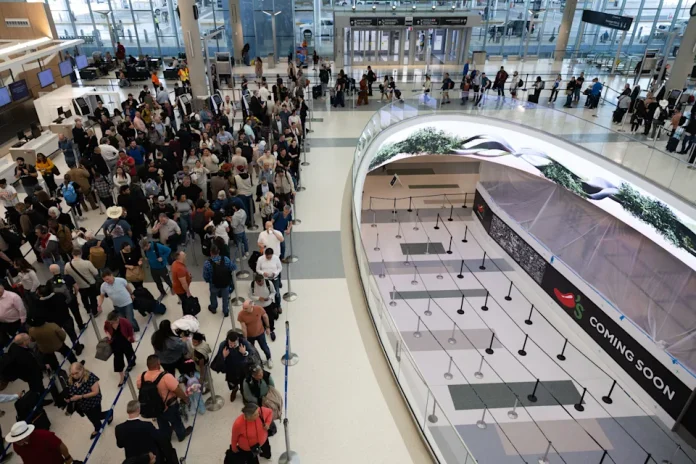
The ongoing partial government shutdown has already led to long lines at airports. Now, Trump administration officials are warning that next week may be a crucial inflection point when travel problems begin to cascade even further.
“This is going to look like child’s play, what’s happening right now,” Transportation Secretary Sean Duffy said in a CNBC appearance on Thursday, warning about next week. “You’re going to see small airports, I believe, shut down. You’re going to see extensive lines, and air travel is almost going to come to a grid halt.”
What’s more, a two-week recess on Capitol Hill is scheduled to begin next Friday, which could see lawmakers absent from Washington until mid-April.
The root of the problem is the ongoing shutdown of the Department of Homeland Security, the sprawling government agency that includes a range of departments, including Immigration and Customs Enforcement (ICE), the Federal Emergency Management Agency (FEMA), and the Transportation Security Administration (TSA).
The shutdown recently passed the 30-day mark, with lawmakers as far apart as ever and the TSA emerging as the major political flash point because of its direct impact on travelers.
TSA workers have been working without pay since Feb. 14. These workers make an average of about $50,000 annually and often need to find other sources of income during shutdowns, which has led to absence rates spiking to five times normal levels, according to officials.
The consequences for travelers: major hubs with wait times of 90 minutes or more in some cases and airport officials urging travelers to arrive 3 hours or more before their flights.
The delays have been most pronounced at airports such as William P. Hobby Airport in Houston, Hartsfield-Jackson Airport in Atlanta, and LaGuardia Airport in New York. But the Trump administration is warning that wider effects could be just around the corner, especially with TSA workers set to miss another paycheck next Friday.
Adam Stahl, the acting deputy administrator of the TSA, noted in a television appearance that “if this continues, it’s not hyperbole to suggest that we may have to quite literally shut down airports,” as he also previewed possible three- to four-hour airport security wait times.
Turbulence ahead, for both travelers and lawmakers
Meanwhile, with the shutdown in its fifth week, efforts on Capitol Hill to end the standoff appear to be making little progress as lawmakers remain at loggerheads over the Department of Homeland Security’s approach to immigration.
Meanwhile, President Trump’s pick for a new leader for the department signaled that he would approach some immigration enforcement issues differently. The White House also previewed possible changes it is willing to make to immigration enforcement.
But a quick break in the impasse still appeared challenging with Democrats calling the proposed changes — such as a promise not to deport US citizens — unserious.
The timing could be tight with both the Senate and House scheduled to go on a two-week recess from March 27 until April 14.
Senate Majority Leader John Thune has hinted that Congress may need to cancel its recess if a compromise isn’t reached, recently telling reporters, “I can’t see us taking a break if the [department’s] still shut down.”
But for the moment, most of the work on Capitol Hill has been focused elsewhere. The Senate is scheduled to spend the weekend debating a sweeping measure to implement stricter voting rules.
Meanwhile, industry groups have upped their calls for a resolution. The US Travel Association spearheaded a new letter Thursday, co-signed by airlines, hotels, and car rental companies, declaring that “the security of travelers and the country is at stake.”
The letter noted the upcoming World Cup and America250 celebrations, saying this “should be a historic year for travel.”
“The flying public cannot afford another day — let alone several weeks or months — of long wait times and increased stress on our nation’s aviation security,” the letter added.
The CEOs of major airlines added their own letter last Sunday, calling on Congress to immediately restore funding and pass legislation that would pay TSA officers during future shutdowns.