The White House insisted that peace talks with Iran are ongoing, even as Tehran publicly rejected US overtures and issued fresh conditions of its own to end the conflict that’s wreaked havoc across the Middle East and global markets.
President Donald Trump insisted Iran was desperate to make a deal to end the nearly month-long hostilities. “They want to make a deal so badly, but they’re afraid to say it,” Trump told congressional Republicans Wednesday night in Washington.
“The United States has been engaged over the last three days in productive conversations,” White House Press Secretary Karoline Leavitt told reporters earlier in the day. “You’re beginning to see the regime look for an exit ramp.”
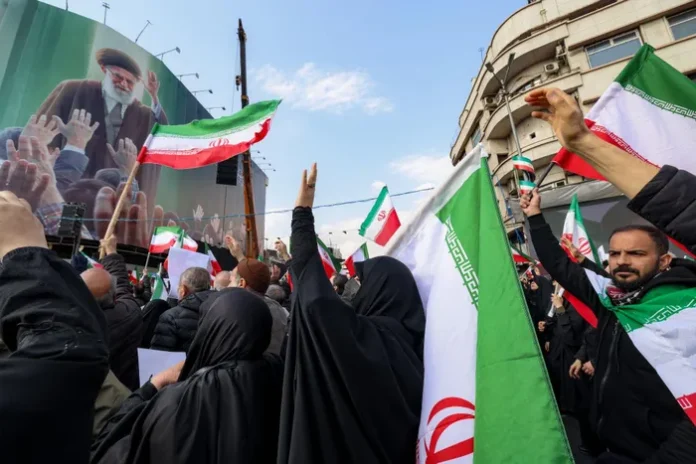
Their comments ran counter to Iran’s earlier statements through state-run media publicly rejecting Trump’s push for talks. Tehran is also seeking its own guarantees, including that the US and Israel won’t resume their attacks, reparations for war damages and recognition of its authority over the Strait of Hormuz, state-owned Press TV said.
As the war grinds on, each side has kept up attacks even amid renewed efforts to jawbone the other into a resolution. Iran’s Press TV reported that the country’s Bushehr Nuclear Power Plant came under fire.
Iran has so far shown little sign of backing down despite relentless Israeli and US bombardment. The UAE said its air defenses were responding to Iranian missile and drone threats Thursday, while Bahrain said an Iranian attack caused a fire at a facility in Muharraq.
Early on Thursday, Iran’s armed forces said they carried out missile strikes targeting American forces and separatist groups backed by the US-Israeli alliance in the northern Iraqi city of Erbil, describing the attacks as part of their latest operations.
Iran is also looking to formalize a transit fee for the Strait of Hormuz, with lawmakers working on a draft bill to impose a toll in exchange for providing security to ships passing via the key waterway, according to the semi-official Fars news agency.
Tehran has already begun charging a limited number of commercial vessels for transit, with payments of as much as $2 million per voyage being sought on an ad hoc basis, according to people familiar with the matter. Since the war started nearly four weeks ago, Iran has effectively shuttered the conduit for about a fifth of the world’s oil and liquefied natural gas, triggering a global supply shock.
Now days away from Trump’s Friday deadline for Iran to negotiate a deal to end the war, there are lingering questions over the status of negotiations and the likelihood for a deal.
The US compiled a 15-point peace proposal that Pakistan delivered to the Islamic Republic, according to people familiar with the matter, highlighting the urgency within Trump’s administration to resolve a conflict it started alongside Israel almost a month ago. Leavitt on Wednesday said there were “elements of truth” to the reported US proposal, but cautioned against speculating on anonymously provided plans.
Vice President JD Vance may travel to Pakistan for Iran talks this weekend, CNN reported. Asked for comment on that report, Leavitt said “this is a fluid situation, and speculation about meetings should not be deemed as final until they are formally announced by the White House.”
The conflict has led to surging fuel and fertilizer prices, with commercial tankers avoiding crossing the Strait of Hormuz and Iranian attacks damaging energy infrastructure. It has also sparked fears of an inflation crisis and worldwide food shortages.
Brent oil is on pace for the biggest monthly gain since 1990 as the US and Iran offer conflicting comments on efforts to end the war. The global crude benchmark rose above $103 a barrel after losing more than 2% on Wednesday, while West Texas Intermediate was near $91.
The risks of further escalation are still substantial. The White House has asserted that Trump is keeping all options open for expanded military action. Washington has ordered more troops to the region, with some set to arrive before week’s end.
“If Iran fails to accept the reality of the current moment,” Leavitt added, “Trump will ensure they are hit harder than they have ever been hit before. President Trump does not bluff and he is prepared to unleash hell.”
Leavitt on Wednesday also announced that a summit between Trump and Chinese President Xi Jinping that was slated for later this month would instead take place in May. Trump had postponed the meeting to keep his focus on the war, which brought fresh strains to US-China ties. Iran is a major trading partner for China, the world’s largest crude importer.
Leavitt said the administration has “always estimated approximately four-to-six weeks” for the conflict when asked if the new dates indicated Trump would look to wind down the war by that point. And she sidestepped a question about whether concluding the war was a precondition for rescheduling the Trump-Xi meeting.
Trump has publicly signaled any peace agreement would have to include a prohibition on Iran ever obtaining a nuclear weapon or enriching radioactive material for civilian purposes.
The US plan stipulates that the Islamic Republic dismantle its main nuclear facilities and use a reduced missile arsenal in self-defense only, according to people familiar with the matter. Iran would retain certain concessions in return, including sanctions relief.
The US leader has said he hopes to reach an agreement by the end of the week. That may be difficult given the wide gaps that remain between the sides, even if talks get officially underway.
It’s also unclear who the US is negotiating with since several top Iranian government and military officials have been killed, including Supreme Leader Ali Khamenei on the conflict’s first day. On Monday, Axios identified Mohammad-Bagher Ghalibaf, Iran’s speaker of parliament, as the likely front man for talks, though he denied negotiations have taken place.
“We are closely monitoring all US movements in the region, especially troop deployments,” Ghalibaf said in a social media post on Wednesday. “Do not test our resolve to defend our land.”
There’s also little clarity over whether Iran would immediately allow all commercial ships to safely transit the Strait of Hormuz without paying, as well as how Israel would respond to any deal. Israeli officials have said they’ll continue striking Iran for now.
Gulf states such as Saudi Arabia and the United Arab Emirates are considering joining the war against Tehran, according to several people with knowledge of the situation. They would only do so if the Islamic Republic attacks vital power and water infrastructure — a high threshold, the people said.
Turkey, meanwhile, is conducting intense diplomacy to try and prevent Gulf Arab countries from becoming involved, according to people familiar with the matter.
More than 4,500 people have been killed in the conflict, according to governments and non-government agencies. Around three-quarters of the fatalities have been in Iran, while more than 1,000 people have died in Lebanon, where Israel is fighting a parallel war against Iran-backed Hezbollah militants. Dozens have been killed in Israel and Arab Gulf states.