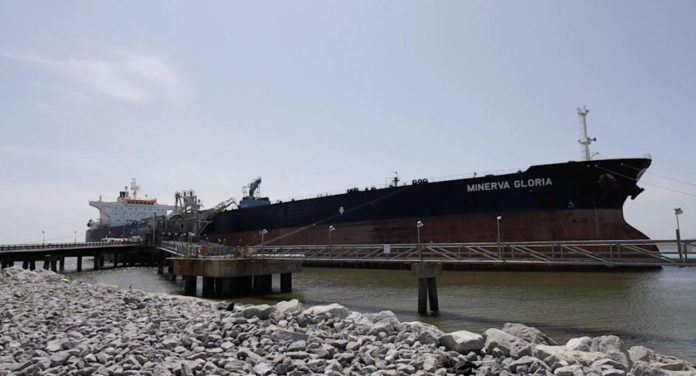
The Minerva Gloria is docked at a wharf in the Mississippi Sound, not far from the US’s vast oil reserves in the Gulf of Mexico.
The ship, 820ft (250m) long, painted navy and burgundy, is carrying precious cargo from Venezuela that, just six months ago, would have been impossible to bring to the US – 400,000 barrels of crude oil.
Venezuela has the world’s largest oil reserves. Under Venezuela’s former president Nicholas Maduro oil exports had dropped significantly, due to a lack of investment. Then came US sanctions against any imports from the Latin American country.
But US President Donald Trump vowed to tap those reserves after the US military captured Maduro in a surprise, night-time raid in January.
Now the oil is flowing again in Venezuela. In March, the country’s monthly crude exports surpassed one million barrels per day. The first time since September.
As the world reels from the impact on global energy prices caused by Iran blocking the Strait of Hormuz, big oil and gas companies like Chevron are now importing Venezuelan crude oil by the shipload.
“It’s a big deal not only for Chevron but the entire Gulf region,” says Tim Potter. He is the director for Chevron’s oil refinery in Pascagoula, Mississippi, the company’s largest operation in the US. It is also the only major US oil company currently operating in Venezuela.
Together this means that Chevron can extract its own Venezuelan oil, process it itself, and get it directly to the US consumer.
“It’s a pretty big incentive for us to run it,” Potter says. “The refinery was really designed, and we invested in the refinery, to run heavy oils like from Venezuela.”
Venezuelan crude oil is relatively cheap to buy because it is much more difficult to process. It is very heavy, thick, dark and high in sulfur, often called a sour oil. It is used to make diesel, gasoline (petrol), jet fuel and other products.
Chevron now imports the equivalent of 250,000 barrels of Venezuelan crude oil per day, on average, says Andy Walz, president of downstream, midstream and chemicals at Chevron.
“We think we can take that up another 50% so call it somewhere around 350,000 to 400,000 barrels a day of just the Chevron share of our position in Venezuela.”
What Walz means by the US’s “position in Venezuela” is that while Chevron is the only US company that has extracting capabilities in the country, others are buying Venezuelan oil from domestic producers.
Chevron is also not the only player when it comes to oil refining in the US. There are 132 refineries in the US that run on a mix of crude oils. And nearly 70% of US refining capacity runs most efficiently with heavier crude.
The US imports very little oil from the Middle East, roughly 8% in 2025. The increase in imports from Venezuela means there is more oil available, which should translate to cheaper gasoline prices for US drivers.
“The United States imports almost no oil through the Hormuz Strait, and won’t be taking any in the future, we don’t need it,” said US President Donald Trump in his primetime address last week.
But just a few miles from the Chevron refinery, at a Chevron fuel station, prices at the pumps continue to increase.
“I hate it,” says David McQueen, retired Vietnam veteran who depends on social security for his livelihood. “The price has got to go down because I’m going down with it.”
When asked why he still pays so much to fill up his car despite being surrounded by the US’s vast oil reserves, McQueen believes the government is sitting on it “to keep the prices up.” He adds: “We’ve got plenty of gas.”
One pump over, Donna fills her tank with $30 (£23) worth of fuel. “I’m driving less and spending less on other things.” Her grandchildren live a few hours away, but she doesn’t see them as often because it has become too costly. “You gotta do what you gotta do.”
The average price for a gallon of gasoline in this part of Mississippi is still cheaper than the national average, according to the American Automobile Association motoring organization. Before the war in Iran, gas was almost $1 cheaper.
In that same evening address, President Trump extolled the US’s oil producing capabilities. “We are the number one producer of oil and gas on the planet, not to mention the millions of barrels we are getting from Venezuela.”
But access to those vast oil reserves hasn’t yet meant lower prices for Americans. That’s because the US is just as susceptible to global oil market fluctuations as other countries.
“While we’re able to still get crude available here to this refinery because of our relatively local supply, the overall pricing of that crude has gone up because it’s based off of world markets,” says Potter.
But Chevron believes its bet on Venezuelan crude will end up benefitting consumers. The Iran war is just currently masking the gains.
“When things do get back to normal, that additional supply out of Venezuela will actually translate to lower prices for Americans. So it will in the future, but it isn’t having an impact now,” says Walz.