One of the U.S. government’s most important activities to increase domestic critical mineral production is being developed without much fanfare: gold (GC=F).
Since last year, the U.S. Department of Interior’s Bureau of Land Management has steadily backed projects and sought public input on gold mining operations.
President Donald Trump named gold along with uranium, copper and potash and other critical minerals in an Executive Order issued March 20, 2025 called “Immediate Measures to Increase American Mineral Production.”
“Our national and economic security are now acutely threatened by our reliance upon hostile foreign powers’ mineral production. It is imperative for our national security that the United States take immediate action to facilitate domestic mineral production to the maximum possible extent,” the order stated.
The top gold-producing countries are China, Russia, Australia and Canada.
In 2025, U.S. gold mine production at 40 lode mines in 12 states yielded some 160 tons valued at $17 billion, up 32% from the previous year, according to the U.S. Geological Survey.
“Nevada was the leading gold-producing state, accounting for about 64% of total domestic production, followed by Alaska, which produced about 22% of domestic gold. About 7% of domestic gold was recovered as a byproduct of processing domestic base-metal ores, chiefly copper ores,” USGS noted.
Trump’s order called on a wide range of federal agencies to increase critical mineral production in numerous ways, including having the Department of Interior prioritize land use for mineral production and mining.
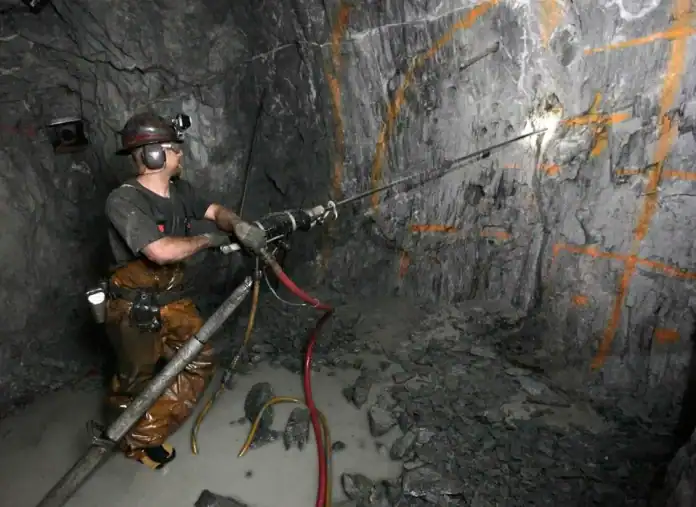
Since then the BLM has developed numerous projects to ramp up gold mining operations.
California
The latest move by the BLM to increase domestic gold output involves seeking public comments by June 1 for a proposed second expansion of an eastern Mojave desert project at the Castle Mountain gold mine.
The plan is to enlarge the open-pit mine by 1,800 acres so it is able to mine four times as much gold yearly—increasing the output from 18 million tons to 80 million tons. The mine is located about 40 miles from Needles and some 60 mines south of Las Vegas.
“If approved, Castle Mountain Venture could expand open pit mining activities within the existing 3,910-acre mine plan boundary,” BLM says.
More in Business
The San Bernardino County gold and silver open pit mine is California’s second largest active gold mine with a proven potential to produce over 4 million ounces of gold.
In another California project, the BLM announced April 8 it okayed a plan by Mojave Precious Metals Inc. to change existing operations to drill exploratory boreholes on public lands where it has mining claims. The project would gather information to guide future mining regarding known mineral deposits, including gold.
Nevada
The BLM in July approved Solidus Resources LLC’s Spring Valley Gold Mine Project to mine public and private lands in Pershing County some 20 miles northeast of Lovelock.
“Planned surface disturbance is about 6,232 acres – 4,123 acres are on BLM-managed public land and 2,109 acres on private land,” BLM noted. “The total life of the project will be 21 years, including two years of construction, 11 years of mining, three additional years of ore processing, and five years of reclamation and closure activities.”
The agency also approved last year the:
County Line gold and silver mine: 452 public acres near Gabbs in Nye and Mineral counties. The County Line Minerals Corp. venture is expected to produce 4.4 million tons of minerals over a four-year period.
Ruby Hill Mine expansion: The project by Ruby Hill Mining Co. LLC will expand the open-pit mine’s gold production operations.
Oregon
Plans are moving forward to develop an underground gold mine and dedicated mill in Oregon called the Grassy Mountain gold and silver mine. It is located on 469 acres of BLM-administered public land and private lands 22 miles south of Vale.
BLM approved the project (proposed by Calico Resources USA Corp., a wholly owned subsidiary of Paramount Gold Nevada Corp.) in January for a mine life of about eight years.
The operation in Malheur County is forecast to produce rage of 47,000 ounces of gold and 55,000 ounces of silver annually.