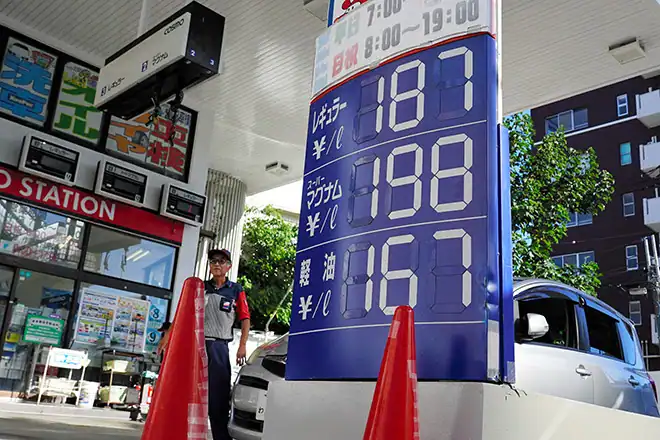
Japan’s government is looking at compiling a supplementary budget to reduce the burden on households from rising fuel bills, two government sources said on Thursday, a move that would put pressure on the country’s strained finances.
A supplementary budget for the current fiscal year would support households that are likely to be hit by elevated gasoline prices and utility bills during the peak-temperature summer season, according to the sources.
Prime Minister Sanae Takaichi will make a decision on the extra budget around a Group of Seven leaders’ summit in France in mid-June, said the sources, who declined to be identified as the matter is private.
The extra budget would come in the form of an additional reserve fund on top of reserves of one trillion yen ($6.34 billion) that are earmarked for the current fiscal year through March next year.
It is not clear how big the supplementary budget could be.
After Kyodo news agency first reported the plan, the yield on the 30- and 40-year Japanese government bonds rose as investors braced for increased debt issuance to fund the extra budget.
The Ministry of Finance was not immediately available to comment.
“The fact the government could compile an extra budget was within market expectations,” said Saisuke Sakai, senior economist at Mizuho Research Institute. “The key would be the size. If the spending is targeted, it could end up being just several trillions of yen.”
“If it turns into a 10-trillion-yen level, markets would get a different impression and could lead to a spike in long-term yields,” he said.
Takaichi has repeatedly downplayed the chances of compiling an extra budget with the view that the government has sufficient funds to pay for current fuel subsidies.
But she has faced growing calls from ruling and opposition lawmakers to come up with a fresh package of plans to cushion the blow from surging oil prices and supply disruptions caused by the U.S.-Israeli war on Iran.
Japan already curbs gasoline prices through subsidies. The government is also looking at tapping existing funds to revive subsidies for electricity and natural gas, a source has told Reuters.
The administration’s fiscal expansionary stance has pushed up super-long bond yields by unnerving investors who are already worried that the Bank of Japan may be behind the curve in dealing with mounting inflationary pressures from the Iran war.
An extra budget would come on top of a record 122-trillion-yen budget for the fiscal year that began in April, which makes up a core part of Takaichi’s “proactive” fiscal policy.
Given its huge public debt, the Organisation for Economic Co-operation and Development on Wednesday urged Japan to discontinue its practice of regularly compiling extra budgets and instead limit their use to combat large shocks.
($1 = 157.8300 yen)